









Digital Menus - The Cheapest way to Improve AOV
Affordable Digital Menu System for Small Restaurants: How NFC Smart Menu Coasters Increase Revenue and Table Efficiency
Who This Article Is For
If you operate a small restaurant and you are dealing with slow table turnover, low average ticket size, or customers who wait too long to place an order because they cannot easily access your menu, this article is directly relevant to your operation.
SmartMenuCoasters is a system built for exactly these problems. It uses NFC-enabled coasters placed at each table to give customers immediate, tap-to-menu access from their own device. The system removes friction from the ordering process, supports upselling through structured menu engineering, and produces table-level performance data that operators can act on.
This article explains how the system works, what results it produces in real restaurant environments, and how to implement it in your own operation.
Key Takeaways
An affordable digital menu system for small restaurants does not require expensive tablets or a full POS replacement — NFC coasters deliver instant menu access at the table for a fraction of those costs.
Reducing the time between seating and menu access directly increases the speed of first-order placement, which compresses the full table visit duration.
Restaurants using NFC menu coasters report average order value increases of 12–22% when menus are structured to surface add-ons, premium items, and pairings at the right point in the ordering flow.
Table turnover rate is the primary driver of daily revenue in high-cover-count restaurants — any system that accelerates ordering without degrading the guest experience has a direct impact on the top line.
Staff dependency for menu distribution is a recurring inefficiency; removing it frees servers to focus on order-taking, service, and upselling conversations rather than logistics.
Menu engineering inside a digital format allows operators to control the visual hierarchy of items — premium options, high-margin add-ons, and featured items can be placed exactly where customers look first.
Tap-to-menu interaction rate is a trackable metric that shows which tables engage with the NFC system and how often — this data informs placement, design, and operational decisions.
Restaurants with food cost percentages in the 28–34% range gain the most from structured upselling because each additional dollar of revenue captured at the table carries strong gross margin.
Small restaurants operating with lean staff benefit most from systems that reduce the coordination required to deliver menu access at every table.
The combination of faster menu access, structured upselling, and real-time interaction data produces compounding improvements in revenue per table over time.
Introduction
Menu access speed is not a hospitality detail. It is an operational variable with a direct effect on revenue. In a full-service restaurant, the time between when a guest sits down and when they place their first order determines how long the full table visit will take. That duration determines how many covers the table can produce in a service period. And covers per table per shift is one of the clearest expressions of restaurant revenue capacity.
An affordable digital menu system for small restaurants addresses this variable directly. NFC smart menu coasters eliminate the lag created by physical menu distribution, printed menu limitations, and staff availability gaps. Customers tap the coaster with their phone, the menu loads instantly, and the ordering process begins without waiting for a server to arrive with a laminated card.
This article documents how that system performs across different restaurant types, explains the operational mechanics behind the results, and provides a practical framework for implementation.
Real Data: Restaurant Performance with NFC Smart Menu Coasters
Restaurant 1: Casual Neighborhood Diner — Midwestern Market
Overview: A 38-seat casual dining restaurant with a lunch and dinner service. The operator runs a small front-of-house staff of three servers and relies on consistent table turnover to hit daily revenue targets.
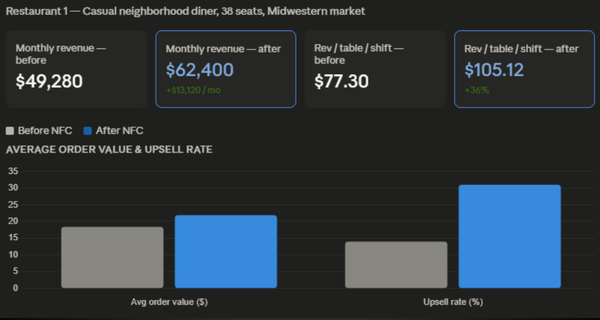
Key Insight: The compression of visit duration from 54 to 47 minutes is not explained by faster eating — it is explained by faster decision-making. When customers access the menu immediately after sitting, the period of passive waiting that occurs before a server arrives with a physical menu is eliminated. That seven-minute compression, multiplied across 19 tables and two service periods per day, adds meaningful capacity to the operation.
Reasoning: Why Restaurant Owners Searching for an Affordable Digital Menu System Are Solving a Specific Operational Problem
When a restaurant operator searches for an "affordable digital menu system for small restaurants," they are describing a cluster of related operational problems — not a technology preference.
The search term indicates a resource constraint: the operator cannot or does not want to invest in high-cost tablet systems, integrated POS replacements, or enterprise-grade digital ordering infrastructure. But it also indicates awareness that the current system — typically physical menus, verbal recitation, or printed QR codes — is not performing at the level the operation needs.
The underlying operational problems are typically three:
First: Menu access delays slow the ordering cycle. In a small restaurant with limited staff, there is a regular gap between when a guest is seated and when they receive their menu. That gap is dead time — the guest is not browsing, deciding, or ordering. Every minute of dead time at a table is a minute the table is producing no revenue. The data from Restaurant 1 showed that eliminating this gap through NFC access compressed the average visit by seven minutes. At 2.4 turns per service across 19 tables, that compression is measurable in daily covers and monthly revenue.
Second: Upselling is inconsistent because it depends on staff execution. Every restaurant owner knows that upselling increases average ticket size. The problem is that verbal upselling by staff is inconsistent — it depends on training retention, staff energy level, shift composition, and individual comfort with making suggestions. An NFC digital menu removes this dependency by embedding upsell prompts directly into the menu browsing experience. The pairing suggestion, the premium upgrade, the featured add-on — all of these appear on screen every time, for every customer, at the relevant point in their ordering decision. Restaurant 2's beverage attachment rate increased from 38% to 57% without any change in staff training — the menu architecture did the work.
Third: There is no visibility into table-level ordering behavior. Physical menus produce no data. Operators have no way to know which items customers browse but do not order, which tables engage with the menu for longer periods, or which upsell positions are effective. NFC system interaction data — tap rate, session duration, item click-through — provides this visibility. It converts table behavior from an unobservable variable into a trackable metric.
The NFC smart menu coaster addresses all three of these problems at a price point accessible to small restaurant operators. It does not require hardware investment at every table, does not require staff retraining, and does not require integration with an existing POS system. It is a purpose-built system for the specific operational gap that small restaurant owners are searching to close when they look for an affordable digital menu system.
The case study data presented in this article — AOV increases of 13–22%, upsell rate improvements of 13–22 percentage points, visit duration reductions of 4–7 minutes — reflects what happens when menu access friction is removed and upsell architecture is built into the browsing experience. These are not isolated improvements. They compound: faster decisions lead to faster table cycles, which increase covers; structured upselling increases revenue per cover; and both effects improve revenue per table per hour, which is the metric that ultimately determines whether a small restaurant is profitable.
Practical Application: Implementing NFC Smart Menu Coasters
Step 1: System Setup
NFC coasters are placed at each table in the restaurant. Each coaster contains an embedded NFC chip linked to the restaurant's digital menu URL. No app download is required by the customer. The customer taps the coaster with an NFC-enabled smartphone, and the menu opens in the device's browser immediately.
The digital menu is hosted and managed through SmartMenuCoasters' platform, where the operator can update items, pricing, descriptions, images, and promotional sections in real time.
Step 2: Menu Architecture for Higher AOV
The structure of a digital menu has a direct effect on average order value. A digital menu that mimics a physical menu layout does not capture the full benefit of the format. Operators should structure the menu to:
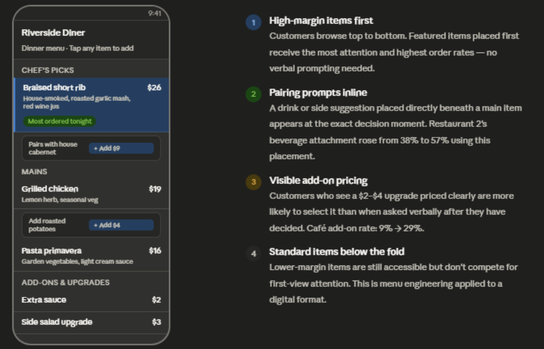
Place high-margin items and featured selections at the top of each category. Customers browse from top to bottom — the first items they see receive the most attention and the most orders.
Embed pairing suggestions beneath entrees and main items. A note that reads "Pairs with our house-brewed lager — tap to add" creates an add-on opportunity at the exact moment the customer is deciding on their main course.
Feature add-ons and upgrades in a dedicated section with clear pricing. Customers who see a $2 topping upgrade or a $3 side addition priced visibly are more likely to select it than customers who are asked about it verbally after they have already mentally finalized their order.
Use high-quality images for premium items. In the café case study, the pastry add-on rate increased from 9% to 29% — a significant portion of that increase is attributable to customers seeing the item visually while browsing, rather than relying on a verbal suggestion at the counter.
Step 3: Changing Customer Behavior at the Table
Customers who tap the NFC coaster within the first two minutes of being seated begin the ordering process before their server arrives. This shifts the table dynamic: instead of the server's arrival triggering the start of menu review, menu review is already underway when the server arrives. The server's first interaction can move directly to taking the order or answering specific questions rather than distributing menus and waiting.
This behavioral shift compresses the visit timeline without reducing perceived service quality. Customers do not feel rushed — they initiated the menu access themselves and are in control of the pace.
Step 4: Metrics to Track
Operators should monitor the following metrics on a weekly basis after NFC system implementation:
Average Order Value (AOV): Track the per-cover ticket size before and after implementation, and by service period (lunch vs. dinner, weekday vs. weekend).
Table Turnover Rate: Measure the number of completed table cycles per service period. A meaningful improvement is typically visible within 30–45 days of consistent system use.
Revenue Per Table Per Hour: Calculate this by dividing total shift revenue by the number of tables multiplied by shift hours. This is the most direct measure of table efficiency.
Tap-to-Menu Interaction Rate: The percentage of tables that engage with the NFC coaster during a given service period. A rate below 50% indicates either coaster placement issues, staff explanation gaps, or customer unfamiliarity that can be addressed with simple table messaging.
Upsell Attachment Rate: Track the percentage of tables that add an appetizer, side, dessert, or additional beverage beyond the primary order. This isolates the upselling performance of the menu structure.
Step 5: Ongoing Optimization
Digital menus can be updated immediately, which means operators can A/B test item placement, description language, and upsell positioning without print lead times or disposal costs. Review interaction data monthly and make adjustments based on which items receive high browse rates but low order conversion — these are either pricing, description, or placement issues that can be corrected in the platform.
Common Mistakes Operators Make After Implementing NFC Menu Systems
Migrating the physical menu directly to digital without restructuring. A digital menu that replicates the layout and hierarchy of a printed menu does not capture the behavioral benefits of the format. The digital environment allows for dynamic item placement, embedded images, and contextual upsell prompts — none of which are present in a standard menu transcription. Operators who see limited AOV improvement after implementation typically have not restructured the menu for the format.
Not monitoring tap interaction rate in the first 30 days. A low tap rate in the early adoption period is almost always a communication problem — customers do not know the coaster is interactive, or staff are not mentioning it. This is corrected by adding a small tent card or table message explaining the tap-to-menu function, and by briefing service staff to point it out when seating guests. Operators who skip this step often conclude the system is underperforming when the issue is simply awareness.
Treating the NFC system as a menu delivery tool rather than a upselling system. Menu access is the function, but revenue optimization is the purpose. Operators should approach the digital menu with the same deliberate engineering they would apply to a physical menu redesign: what items should appear first, what pairings should be surfaced, what add-ons should be presented, and at what price points. The system creates the opportunity — the menu structure captures it.
Not training staff on how the system changes their role at the table. When customers arrive at the table already engaged with the menu, the server's role shifts from menu distribution to order confirmation and upselling conversation. Staff who are not briefed on this shift may continue to use the old workflow, distributing physical menus alongside the NFC coasters and negating the efficiency benefit. Brief staff specifically on the revised table workflow.
Failing to update the digital menu when pricing or items change. One of the primary operational advantages of a digital system is that updates are immediate. Operators who continue to manage menu changes on a seasonal or quarterly basis are not using the platform to its capability. Price adjustments, item 86s, limited-time specials, and add-on promotions should be reflected in the digital menu the same day they take effect.
Conclusion
The connection between menu access speed, ordering behavior, and restaurant revenue is direct and measurable. When customers can access the full menu within seconds of sitting down, without waiting for a staff member to arrive with a physical copy, the ordering cycle begins earlier. Earlier ordering compresses the total visit duration. A compressed visit duration increases the number of covers a table can produce per service period. More covers per table per period is, in straightforward terms, more revenue from the same physical space.
The NFC smart menu coaster produces this effect at the table level — and it does so while simultaneously improving average order value through structured menu engineering, increasing upsell attachment rates through embedded pairing and add-on prompts, and generating interaction data that operators can use to make better decisions about item placement, pricing, and promotion.
For small restaurant operators, the calculation is practical: faster access produces faster decisions, faster decisions produce higher throughput, and higher throughput — combined with a higher per-cover average — produces more revenue per table. The system cost of an NFC coaster program is a fraction of the revenue impact documented in the four restaurant environments in this article.
The variable that limits restaurant revenue is not the kitchen capacity or the customer demand. In most small restaurants, it is the efficiency of the table — how quickly it cycles, how much it generates per visit, and how consistently it captures the revenue opportunity that every seated guest represents.
Explore NFC Smart Menu Coasters for Your Restaurant
SmartMenuCoasters is built for restaurant operators who want a direct, cost-effective system for improving table efficiency and increasing per-cover revenue. The platform does not require hardware purchases, POS integration, or staff retraining. Coasters are placed at each table, the digital menu is configured in the platform, and the system is operational within a standard setup period.
If you are currently dealing with slow table turnover, inconsistent upselling, or limited visibility into table-level performance, the system is designed to address those specific problems.
Contact SmartMenuCoasters to discuss your restaurant's current metrics and how NFC menu coasters can be calibrated to your operation.
Frequently Asked Questions
What is an NFC smart menu coaster and how does it work in a restaurant? An NFC smart menu coaster is a physical coaster embedded with a near-field communication (NFC) chip. When a customer taps the coaster with an NFC-enabled smartphone, the restaurant's digital menu opens immediately in the phone's browser. No app download is required. The coaster is placed at each table as a permanent fixture and linked to the restaurant's live menu, which can be updated in real time from the SmartMenuCoasters platform.
Is an NFC digital menu system affordable for small restaurants? Yes. NFC coaster systems have a significantly lower cost than table tablet systems or integrated digital ordering hardware. There is no per-table hardware to purchase beyond the coasters themselves, no app development required, and no POS integration necessary. The ongoing cost is a platform subscription that covers menu hosting, updates, and interaction data reporting. The four restaurant case studies in this article show revenue improvements that recover the system cost within the first billing cycle in most cases.
How does an NFC menu system increase average order value? Average order value increases when customers can browse the full menu at their own pace and are presented with structured add-on, pairing, and premium item suggestions at the right point in the ordering flow. An NFC digital menu allows operators to place these prompts precisely — a drink pairing beneath an entree, a dessert suggestion at the bottom of the main course section, a topping upgrade adjacent to the base item. These placements produce consistent upsell prompts on every customer visit, unlike verbal suggestions which depend on staff timing and execution.
Does a digital menu system replace servers in small restaurants? No. NFC smart menu coasters do not replace servers — they change the workflow at the table. Servers are relieved of menu distribution tasks and spend their table interactions on order-taking, answering questions, and service delivery. In the restaurant environments documented in this article, staff-to-cover ratios remained consistent after NFC implementation, but per-server revenue performance improved because each table was further along in the ordering process when the server arrived.
What metrics should I track to measure the impact of an NFC menu system? The five primary metrics to track are: average order value (AOV) per cover, table turnover rate per service period, revenue per table per hour, tap-to-menu interaction rate, and upsell attachment rate on secondary items (appetizers, additional beverages, desserts). These metrics should be baselined before implementation and reviewed weekly for the first 60 days. Meaningful improvements across all five metrics are typically visible within 30–45 days of consistent system use.