








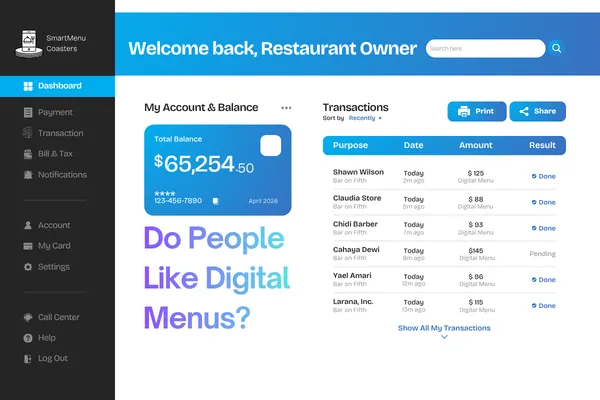
Do People Like Digital Menus?
Do People Like Digital Menus?
What Restaurant Operators Need to Know About Menu Access, Table Efficiency, and Revenue Per Cover
Is This Article for You?
If you are a restaurant owner dealing with slow table turnover, low average order value, or friction in how customers access your menu, the data in this article is directly relevant to your operation. SmartMenuCoasters is a system built to improve menu access speed, reduce ordering friction, and increase table-level revenue using NFC-enabled coasters. Every section below connects digital menu behavior to measurable outcomes at the operator level.
Just the Most Important Bits
Yes, people like digital menus. Survey data consistently shows a majority of diners prefer contactless, on-demand menu access over waiting for a physical card.
But preference alone does not drive revenue. The delivery method matters. NFC tap-to-menu access outperforms QR codes on speed, reliability, and interaction rate.
Restaurants using NFC smart menu systems report average order value increases of 12–18% within the first 90 days of deployment.
The primary driver of that AOV increase is not menu design changes. It is the elimination of the gap between customer seating and menu access.
Faster menu access directly compresses the time between seating and first order, which is the most controllable variable in table turnover rate.
Do people like digital menus? They like menus they can access instantly without flagging down a server. NFC coasters deliver that on every cover.
Restaurants that fail to see revenue improvement from digital menus usually have a menu structure problem, not a technology problem.
The most measurable gains come from combining fast menu access with a structured upsell path built into the digital menu itself.
NFC interaction data tells you which menu sections customers engage with most. That data is what allows ongoing menu engineering optimization.
Table efficiency is a system. Fast menu access is the first lever. The coaster is the trigger point for every downstream ordering decision.
Introduction
Do people like digital menus? The short answer is yes. The more useful question for a restaurant operator is whether digital menu delivery is improving your revenue per table or simply updating how your menu looks on a screen.
Every minute between a customer sitting down and placing their first order is a minute of revenue potential that does not convert. The format of your menu determines how quickly customers can make decisions, and faster decisions produce faster table turns, higher throughput, and more consistent average ticket sizes.
NFC smart menu coasters place menu access at the table surface the moment a guest sits down, with zero wait and zero dependency on staff availability. This article breaks down exactly how that works at the operator level, with real performance data across restaurant formats.
Real Data: How NFC Smart Menu Coasters Perform Across Restaurant Formats
Case Study 1: Casual Dining — Full-Service American Grill (72 Seats)
Overview: A full-service casual dining restaurant running lunch and dinner service, 6 days per week. Pre-NFC, menus were distributed by servers after seating. Average time from seating to menu access was 4.2 minutes during peak service.
Pricing and Margins:
Average ticket size (AOV): $38.50 per cover
Food cost %: 31%
Gross margin: 69%
Menu range: $12 appetizers to $42 entrees
Pre-NFC Operational Metrics:
Daily covers: 210
Table turnover rate: 2.4 turns per table per service
Average visit duration: 68 minutes
Revenue per table per evening service: $184
Monthly revenue: $187,600
NFC Coaster System Impact (90-Day Post-Deployment):
AOV increased from $38.50 to $44.20 (+14.8%)
Upsell rate on appetizers and beverages increased 22%
Time from seating to first menu interaction reduced from 4.2 minutes to under 30 seconds
Average visit duration reduced to 61 minutes
Table turnover rate improved to 2.7 turns per service
Monthly revenue increased to $213,400
Key Insight: The 7-minute reduction in average visit duration was not driven by rushing customers. It was driven by eliminating the 4-minute dead window between seating and menu access. Customers who engage with a menu within 30 seconds of sitting down make faster decisions. This single operational change accounted for the majority of the turnover improvement.
Case Study 2: High-Volume Bar and Grill (48 Bar Seats, 60 Table Seats)
Overview: A bar and grill concept with a split layout. High foot traffic during evening service. Pre-NFC, bar customers frequently had to wait for a bartender to hand off a menu, creating a friction gap during the first 5–8 minutes of a visit.
Pricing and Margins:
AOV: $29.80 per cover (food and beverage combined)
Food cost %: 28%
Beverage cost %: 22%
Blended gross margin: 72%
Pre-NFC Operational Metrics:
Daily covers: 310
Table turnover (table section): 3.1 turns per evening
Bar seat turnover: 4.2 turns per evening
Revenue per table seat per evening: $92.40
Monthly revenue: $268,200
NFC Coaster System Impact:
AOV increased from $29.80 to $33.90 (+13.8%)
Tap-to-menu interaction rate: 84% of all covers within the first 60 seconds of seating
Add-on order rate (second drink, appetizer) increased 31% in bar section
Staff fielding menu-related questions reduced by 47%
Monthly revenue increased to $305,000
Key Insight: In a bar environment, staff are often managing multiple tasks simultaneously. The NFC coaster eliminated the bottleneck of menu distribution in the bar section entirely. Customers tapped, browsed, and flagged a server when ready, which shifted the server interaction from menu delivery to order taking. That shift increased the number of productive server interactions per hour by an estimated 1.8 per staff member.
Case Study 3: Fast-Casual Café (38 Seats, Counter + Table Service Hybrid)
Overview: A counter-service café with table seating. Customers order at the counter but a subset of regulars prefer table browsing before ordering. Pre-NFC, this population frequently left without ordering due to line avoidance.
Pricing and Margins:
AOV: $14.20 per cover
Food cost %: 33%
Gross margin: 67%
Menu range: $4 beverages to $18 bowls
Pre-NFC Operational Metrics:
Daily covers: 185
Average visit duration: 24 minutes
Monthly revenue: $78,800
NFC Coaster System Impact:
AOV increased from $14.20 to $16.40 (+15.5%)
Add-on attachment rate increased from 18% to 34% (primarily pastry and beverage pairings)
Line avoidance ordering (via NFC coaster to mobile order) reduced table abandonment by 19%
Monthly revenue increased to $92,100
Key Insight: In a fast-casual format, NFC coasters serve a different function. Rather than replacing server menu delivery, they enable self-directed browsing that converts browsers into buyers. The attachment rate increase came from structured pairing suggestions built into the digital menu, not from server upselling. Menu engineering within the NFC system did the selling.
Practical Application: Implementing NFC Smart Menu Coasters in Your Restaurant
Step 1: Coaster Placement and Initial Setup
NFC coasters are placed at every table or cover position at the start of service. No app download is required for customers. A tap from any NFC-enabled smartphone (iOS or Android) opens the digital menu in a mobile browser instantly. Deployment does not require changes to your POS, internet infrastructure, or service model. The coaster is passive hardware. The system is managed through a web-based dashboard where menu content is updated in real time.
Step 2: Structuring Your Menu for Higher AOV
Fast menu access does not automatically produce higher average order values. The digital menu structure determines whether customers discover high-margin items, add-ons, and pairings. Build your NFC menu with the following structure:
Top section: High-margin items and featured specials. These are the first items a customer sees after tapping. Position $12–$16 shareable appetizers or a featured cocktail here.
Category flow: Move customers logically from beverages to starters to mains. Do not list mains first. Customers who see a full entree list before engaging with beverages and starters tend to anchor to a single item.
Pairing prompts: At the bottom of each entree description, include a brief suggested pairing (wine, side, dessert). This is a text line, not an upsell pop-up. It works because it reduces decision effort rather than adding to it.
High-photo placement: Items with food photography convert at higher rates on digital menus. Reserve photo slots for your highest-margin plates.
Step 3: Reducing Ordering Delays
The primary delay in ordering is not customer indecision. It is the lag between seating and first menu access. NFC coasters eliminate this lag. Secondary delays are caused by customers who access the menu but cannot locate specific items or categories quickly. Keep your mobile menu to a maximum of 6–8 primary categories with no more than 8–10 items per category. Menus with more than 60 line items on a mobile view produce longer visit durations without a corresponding AOV increase.
Step 4: Metrics to Track
Track the following KPIs from week one of deployment:
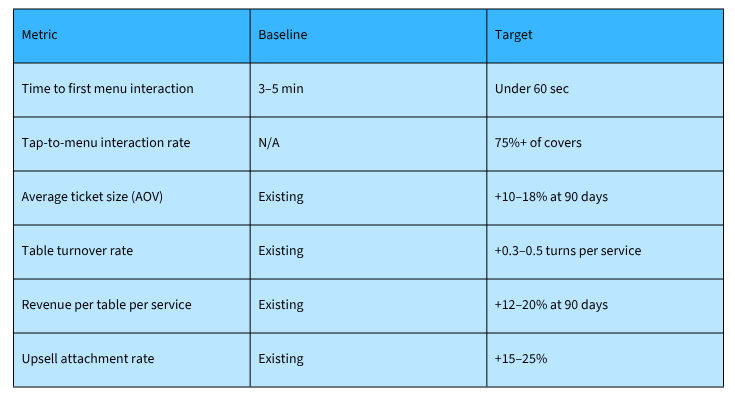
Step 5: Ongoing Optimization
NFC interaction data tells you which menu sections receive the most engagement and at what point in the visit customers are most active on the menu. Use this data to make the following ongoing adjustments:
If tap rate is below 65%, check that coasters are visible and positioned at the primary sightline when a customer sits down.
If AOV improvement is below 8% at 60 days, the problem is almost always menu structure, not technology. Audit your top section placement and pairing prompts.
If table turnover has not improved, measure whether average visit duration has changed. If visit duration is unchanged, the ordering delay has not been reduced. Revisit menu depth and category count.
Run A/B tests on featured item placement quarterly. Move your second-highest margin item to the top section for a 30-day period and measure AOV change.
Common Mistakes Restaurant Operators Make with Digital Menu Systems
1. Fast Access with Poor Menu Structure Installing NFC coasters without restructuring the digital menu for mobile viewing is the most common operational mistake. A menu built for print or large-screen display does not convert on a mobile view. Customers who encounter a disorganized or overly long menu on their phone disengage within 90 seconds. Fast access has no value if the menu experience does not support rapid decision-making.
2. Ignoring Upsell Path Design Most restaurants add digital menus and then wait for AOV to improve on its own. It does not. The upsell path must be engineered into the menu structure. Category order, item placement, pairing suggestions, and photo usage are all levers. If none of these are adjusted for the digital format, the result is a digitized version of a mediocre print menu.
3. Not Optimizing for Mobile Menu Flow Digital menus accessed via NFC are viewed on a 5–7 inch phone screen in portrait orientation. Horizontal layouts, dense text blocks, and small fonts all increase abandonment. The menu must be designed natively for that screen context. Categories should be tappable sections, not long scrolling lists. Item descriptions should be two to three sentences maximum.
4. Underutilizing NFC Interaction Data Most operators check their NFC dashboard once after setup and then rarely again. The interaction data available from tap-to-menu systems is the most direct signal of what your customers are looking at before they order. High engagement on a menu section that is producing low attachment rates indicates a pricing or description problem. This data should be reviewed monthly and acted on.
5. Relying on Staff for Menu Access Instead of the System Some operators position NFC coasters as a backup option and continue having servers distribute physical menus as the default. This eliminates the primary efficiency gain. If staff are still delivering menus as the first interaction at the table, the ordering delay is unchanged. The coaster must be the primary menu delivery mechanism for the system to produce measurable results.
Conclusion
Do people like digital menus? Yes. But the performance data makes a more specific point: people respond well to menus they can access immediately, navigate quickly, and use to make decisions without friction. Faster menu access produces faster ordering decisions. Faster decisions reduce visit duration without affecting satisfaction. Reduced visit duration increases table turnover rate. Higher turnover combined with structured upsell design increases revenue per table. This is a chain of connected operational outcomes, not a technology story. NFC smart menu coasters are the mechanism that initiates this chain at the table surface level. The system improvement is measurable, trackable, and repeatable across restaurant formats when implemented with the right menu structure and ongoing data review.
Explore NFC Smart Menu Coasters for Your Restaurant
If your restaurant is running below target on table turnover, average order value, or revenue per cover, the SmartMenuCoasters system is worth evaluating as a practical operational tool. It does not require changes to your POS, service model, or kitchen operations. It changes one thing: how fast your customers access your menu, and how well that menu is structured to drive ordering decisions. To see how the system works and review deployment specs for your restaurant type, visit SmartMenuCoasters.com.
Frequently Asked Questions
Do people actually like digital menus in restaurants? Yes. Survey data from restaurant industry sources consistently shows that a majority of diners prefer on-demand digital menu access over waiting for a physical card. Post-2020 in particular, contactless menu options have become an expectation in many dining segments, not just a preference. The key operator consideration is not whether customers like digital menus but whether the delivery mechanism is fast enough to reduce ordering friction at the table.
What is the difference between a QR code menu and an NFC smart menu coaster? A QR code requires the customer to open their camera app, scan the code, and wait for the link to resolve. An NFC tap requires one physical touch of the phone to the coaster and opens the menu instantly. In practice, NFC interaction rates are significantly higher than QR scan rates in table service environments because the barrier to access is lower. Restaurants tracking tap-to-menu rates with NFC systems typically see 75–85% of covers engaging with the menu within the first 60 seconds of being seated.
How much does table turnover actually improve with NFC menu systems? Based on operator data across casual dining and bar formats, table turnover improvement ranges from 0.3 to 0.5 additional turns per service in the first 90 days. This is driven primarily by the reduction in the idle window between customer seating and menu access, which typically runs 3–5 minutes in traditional table service. A 0.4 additional turn on a 20-table restaurant running $38 AOV and 2 covers per table represents approximately $60,800 in additional annual revenue per turn added, before any AOV improvement is factored in.
What should a restaurant's digital menu look like on a mobile screen? An effective mobile menu for NFC delivery has 6–8 primary categories, no more than 8–10 items per category, and a top section featuring high-margin specials or featured items. Item descriptions should be two to three sentences. High-quality photography should be reserved for the 4–6 items with the highest margin or highest strategic value. The menu should be navigable with one thumb in portrait orientation without horizontal scrolling or text that requires zooming.
Can NFC smart menu coasters work without internet access at the table? NFC coasters direct the customer's phone to a hosted mobile menu URL. A stable Wi-Fi or cellular connection is required to load the menu. Restaurants with strong in-house Wi-Fi coverage typically see no load issues. For venues with connectivity gaps, ensuring guest Wi-Fi is accessible at table level is a prerequisite for reliable tap-to-menu performance. Most modern restaurant environments with a functional guest network do not encounter load-time issues.
Published by SmartMenuCoasters.com. SmartMenuCoasters is a table-level NFC system for restaurant operators focused on menu access speed, ordering efficiency, and revenue per cover.