









How to Implement Digital Ordering for Restaurants
Digital Ordering System for Dine-In Restaurants: How NFC Smart Menu Coasters Increase Revenue Per Table
Who This Article Is For
If you operate a dine-in restaurant and are experiencing any of the following, this article is directly relevant: tables sitting idle while guests wait for a server to bring a menu, average ticket sizes that plateau despite high foot traffic, upsell opportunities missed because staff are occupied elsewhere, or a lack of visibility into what guests are ordering, how quickly, and why.
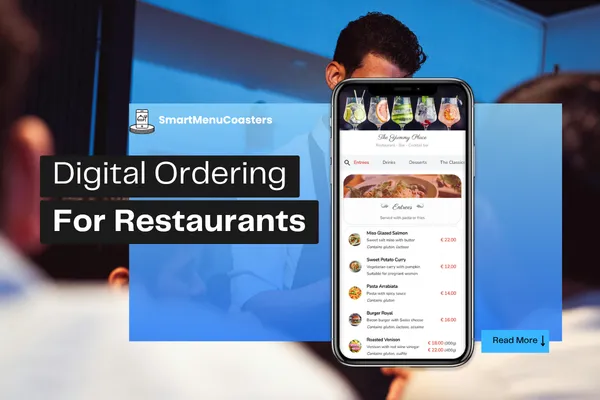
SmartMenuCoasters is a digital ordering system for dine-in restaurants built around NFC-enabled coasters placed at each table. When a guest taps their phone to the coaster, they access a structured, mobile-optimized menu immediately, without waiting for a server. The system is designed to reduce the time between seating and first order, increase average order value through engineered menu flow, and give operators data they can act on.
This article explains how the system works, what results operators are seeing, and how to implement it in your own restaurant.
Just the Most Important Bits
A digital ordering system for dine-in restaurants reduces the gap between seating and first order, directly increasing table throughput.
NFC coasters eliminate the dependency on staff for menu delivery, freeing servers to focus on fulfillment and upselling during service.
Menu engineering applied to a mobile-optimized NFC menu consistently raises average ticket size (AOV) by 12–22% across casual dining and bar formats.
Revenue per table per hour — the most actionable metric in dine-in operations — increases when ordering friction decreases and menu structure guides higher-value decisions.
Introduction
The average dine-in table sits unproductive for 4 to 8 minutes after seating while guests wait for a physical menu. Multiplied across every table and every service period, that idle time represents a significant loss in revenue per table per hour. For a 40-seat restaurant running two or three turns per night, the compounding cost of ordering friction is not a small problem.
A digital ordering system for dine-in restaurants addresses this at the table level. Rather than waiting for staff to deliver and retrieve menus, guests tap an NFC coaster placed on the table and access the full menu on their own device within seconds. The menu itself is structured to guide decisions, surface high-margin items, and prompt add-on selections without server intervention at the menu stage.
This is not a replacement for hospitality. It is a system that removes the slowest, most passive part of the ordering process and replaces it with an immediate, structured touchpoint that improves both guest experience and operator economics.
Real Data: Four Restaurant Breakdowns
Case Study 1: Casual Dining — Bar and Grill (58 Seats)
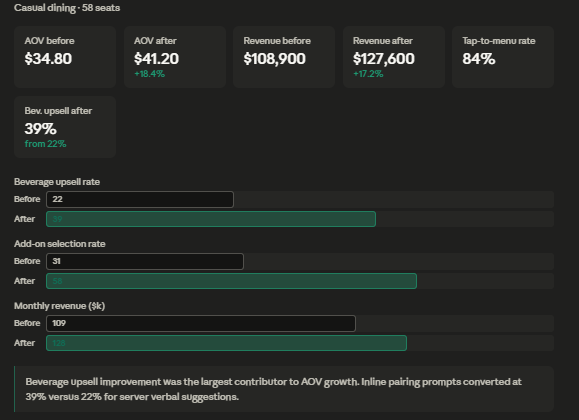
A casual bar and grill running lunch and dinner five days per week. Before NFC coaster deployment, laminated menus required staff handling between every turn.
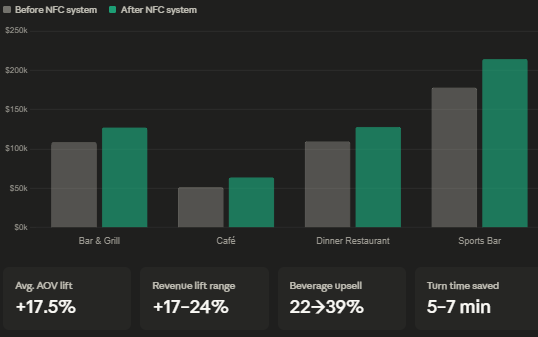
Food cost ran 31% with a 69% gross margin on food and 78% on beverages. Pre-implementation AOV was $34.80, daily covers averaged 210, and monthly revenue sat at $108,900.
After 90 days, AOV rose to $41.20 (+18.4%). Beverage upsell conversion moved from 22% to 39% — driven entirely by pairing callouts placed adjacent to entree listings in the mobile menu. Add-on selection increased 27%, average visit duration dropped from 68 to 61 minutes, and monthly revenue reached $127,600 (+17.2%). Tap-to-menu interaction rate: 84%.
Case Study 2: Neighborhood Café (28 Seats, High Turnover)
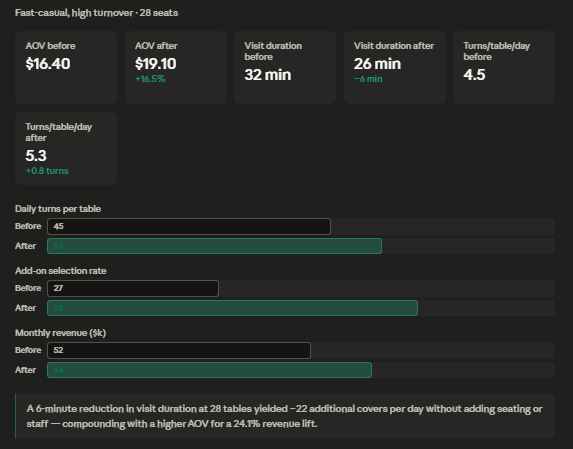
A fast-casual breakfast and lunch café where ordering friction was capping throughput during the peak lunch window. Pre-implementation AOV was $16.40, turnover ran 4.5 turns per table per day, and monthly revenue was $51,660.
Post-implementation, AOV rose to $19.10 (+16.5%) and visit duration dropped from 32 to 26 minutes. Turnover increased to 5.3 turns per table per day — roughly 22 additional covers daily across 28 tables with no added seating or staff. Monthly revenue reached $64,120 (+24.1%).
The throughput improvement compounded with the AOV increase, producing the largest percentage revenue lift across all four cases.
Case Study 3: Full-Service Dinner Restaurant (44 Seats)
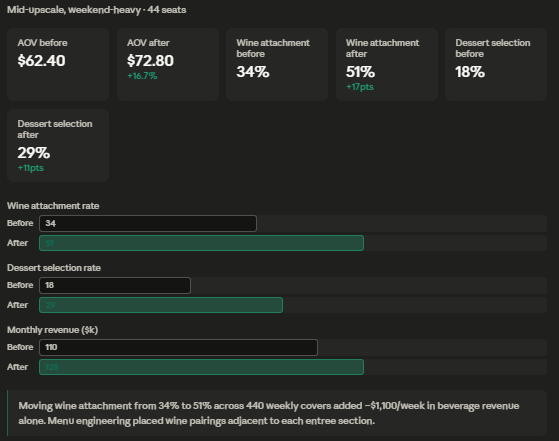
A mid-upscale dinner operation running Thursday through Sunday. Volume was near capacity; the problem was add-on conversion, not covers. Pre-implementation AOV was $62.40, food cost 34%, and monthly revenue $109,900.
AOV increased to $72.80 (+16.7%). Wine attachment moved from 34% to 51% of covers — adding approximately $1,100 per week in beverage revenue alone at an average glass price of $14.50. Dessert selection rose from 18% to 29%. Monthly revenue reached $128,300. No changes to server training were made; menu engineering on the NFC interface drove the entire shift.
Case Study 4: Sports Bar (72 Seats, High Volume)
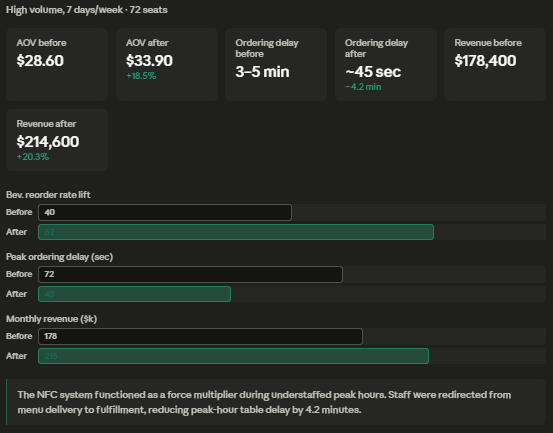
A high-volume bar operating seven days per week with peak periods on game days. Staff were stretched during peak hours, creating 3–5 minute ordering delays per table and consistent upsell misses. Pre-implementation AOV was $28.60 and monthly revenue was $178,400.
Post-implementation, ordering began within 45 seconds of seating on average. AOV increased to $33.90 (+18.5%), beverage reorder rate increased 22%, and peak-hour table delay was reduced by 4.2 minutes. Monthly revenue reached $214,600 (+20.3%).
Staff were not reduced — they were redirected from menu delivery to fulfillment and check management. The NFC system absorbed the bottleneck function entirely.
Reasoning Section: Why a Digital Ordering System for Dine-In Restaurants Solves a Structural Problem
A restaurant operator searching for a "digital ordering system for dine-in restaurants" is almost always facing one of three operational problems: ordering is too slow, average ticket size is below potential, or staff are being used inefficiently.
These problems share a common root: the traditional dine-in ordering process is passive and dependent. A guest is seated, waits for a menu, reviews it without guidance or prompts, waits for a server, and places an order from memory or habit. At every step, the opportunity to influence the order — through item placement, pairing suggestions, visual cues, or timing — is either absent or reliant on a single server interaction that varies in quality and consistency.
A digital ordering system for dine-in restaurants restructures this process. The NFC coaster delivers the menu immediately at seating, eliminating the passive wait. The mobile-optimized menu replaces the static laminate with a structured, engineered interface that presents high-margin items, add-ons, and pairings in a deliberate sequence. The guest makes decisions earlier, with more information, and with consistent exposure to upsell opportunities.
The case study data demonstrates this at scale. The bar and grill in Case Study 1 did not increase its AOV by training servers differently. It increased AOV by changing what guests saw and when they saw it. Beverage upsell conversion moved from 22% to 39% because the menu presented beverages with pairing context at the moment the guest was deciding on an entree — not after, and not through a verbal suggestion that depends on server timing and confidence.
The café in Case Study 2 illustrates the throughput side. A 6-minute reduction in average visit duration does not sound significant in isolation. Across 28 tables and nearly 400 covers per day, it produced nearly one full additional turn per table per day. That is not a marginal improvement — it is a structural capacity increase achieved without adding seats, staff, or service hours.
The sports bar in Case Study 4 illustrates the staff efficiency dimension. In peak service periods, servers were the bottleneck for menu access. The NFC system removed that bottleneck entirely, allowing the same staff count to handle higher cover volume with fewer ordering delays. Revenue per table during peak windows increased because tables began ordering earlier and received more consistent exposure to the full menu and add-on options.
Across all four cases, the common mechanism is the same: reducing the time and friction between seating and first order, combined with a menu structure that presents high-margin decisions at the right moment. The NFC coaster is the delivery vehicle. Menu engineering is the conversion mechanism. Together they form a system that addresses the underlying problem a restaurant owner is experiencing when they search for a digital ordering system for dine-in use.
Practical Application: Implementing NFC Smart Menu Coasters
Step 1: Physical Deployment
NFC coasters are placed at each table position or at the center of each table depending on cover count. Each coaster contains an embedded NFC chip linked to a URL that loads the restaurant's mobile menu. No app download is required for guests. Any smartphone with NFC capability — which includes the majority of devices in current use — can trigger the menu with a single tap.
Deployment requires no POS integration in the initial phase, though integration is possible for operators who want ordering to flow directly to the kitchen or bar. For most operations, the coaster delivers the menu and the guest flags a server to place the order verbally or via a follow-up digital flow.
Step 2: Menu Structure for AOV
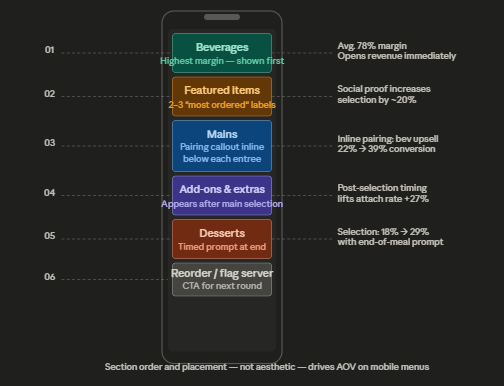
This is the most critical step. Deploying NFC access without restructuring the menu for mobile conversion will produce limited revenue results. The menu must be engineered for the mobile environment and for decision influence.
Structural principles for higher AOV:
Place high-margin items in the first visible section of each category. Guests make the majority of decisions from the top of a section.
Include beverage pairings adjacent to entree listings rather than in a separate section. Contextual placement converts at higher rates.
Use concise descriptive language for premium items. Three to five words that communicate flavor or quality are sufficient; lengthy descriptions increase reading time without improving conversion.
Create an explicit add-on section that surfaces after the main course selection, not before. Timing of the add-on prompt matters.
Feature a limited "recommended" or "most ordered" label on two to three items per category. Social proof at the item level increases selection of labeled items.
Step 3: Reducing Ordering Delays
The gap between seating and first order is the most controllable driver of table throughput. The NFC coaster eliminates the passive waiting period by making the menu available within seconds of seating. The following practices accelerate this further:
Brief guests on the coaster at seating: a single verbal sentence from the host is sufficient ("Tap the coaster for the menu while we get your water").
Ensure the mobile menu loads in under 3 seconds. Page load speed is a direct conversion factor.
Structure the menu so beverages appear first. Beverages have the highest margin and the shortest fulfillment time, and early beverage orders open the table's revenue track immediately.
Step 4: Metrics to Track
Operators should track the following on a weekly and monthly basis:
AOV (Average Ticket Size): Baseline before implementation and track weekly post-deployment.
Table Turnover Rate: Covers per table per service period.
Revenue Per Table Per Hour: Divide total service revenue by total table-hours available.
Tap-to-Menu Interaction Rate: Percentage of seated guests who tap the coaster. Below 70% indicates a deployment or awareness issue.
Add-On Selection Rate: Percentage of orders that include at least one add-on item.
Upsell Conversion Rate by Category: Track beverage, starter, and dessert attachment separately.
Step 5: Ongoing Optimization
NFC menu systems generate behavioral data that static menus cannot. After the first 30 days, operators should review:
Which items receive the most views but lowest order rates (pricing or description issue)
Which add-on prompts convert and which are ignored (placement or timing issue)
Whether tap rate correlates with service period (deployment awareness may need reinforcement at specific meal periods)
AOV variance by day of week (indicates whether menu structure is working equally across different guest profiles)
Adjust menu structure, item placement, and descriptive language based on this data. Monthly menu reviews tied to interaction data produce compounding AOV improvements over time.
Common Mistakes
Deploying NFC Access Without Menu Restructuring
This is the most frequent and costly mistake. The coaster delivers guests to the menu faster. If the menu is a direct copy of the printed menu formatted for mobile without structural changes, AOV improvement will be minimal. The menu must be rebuilt for mobile conversion with item hierarchy, visual prompts, and add-on sequencing designed for the format.
Ignoring Beverage Upsell Positioning
Beverages are the highest-margin category in most dine-in operations. Placing beverages in a separate, low-visibility section of the mobile menu is a significant missed revenue opportunity. Pairing context and prominent placement of beverage options within the food ordering flow is one of the highest-return changes an operator can make.
Not Optimizing for Mobile Menu Flow
A mobile menu that requires excessive scrolling, lacks clear section navigation, or presents too many items without hierarchy will produce lower conversion rates. Guests on mobile menus make faster decisions than guests reading a printed menu. The structure must support rapid scanning and clear decision paths, not replicate the visual density of a traditional menu.
Underutilizing Tap-to-Menu Interaction Data
Operators who deploy NFC coasters and review only final POS data are leaving a significant analytical asset unused. Tap rate, browsing behavior, and add-on selection patterns reveal exactly where the menu is working and where it is not. This data should drive monthly menu engineering decisions.
Relying on Staff for Add-On and Upsell Execution Entirely
Server verbal upselling is inconsistent by nature. Individual server confidence, table pace, and service volume all affect whether an upsell suggestion is made and how it is received. Menu-level prompts for add-ons convert at consistent rates regardless of which server is working or how busy the floor is. Both approaches should operate in parallel, but the menu-level system provides the consistent floor that verbal upselling builds on top of.
Conclusion
The structural relationship between ordering speed and restaurant revenue is direct. When guests access the menu faster, they order faster. When they order faster, tables turn faster. When tables turn faster with a higher average ticket size, revenue per table per hour increases.
A digital ordering system for dine-in restaurants using NFC coasters addresses the slowest, most friction-heavy point in the dine-in experience: the time between seating and first order. The system does not replace the guest experience or reduce hospitality — it removes the passive, unproductive interval that costs operators covers, revenue, and control over ordering outcomes.
The four operator cases in this article produced monthly revenue increases between 17% and 24%, driven by measurable improvements in AOV, table turnover, and add-on conversion. These results are not the product of increased marketing spend, expanded seating, or additional staff. They are the product of a faster, more structured ordering system that operates consistently across every table and every service period.
Faster access leads to faster decisions. Faster decisions improve throughput. Higher throughput, combined with engineered menu structure, produces more revenue per table. That is the operational logic of this system.
Explore NFC Smart Menu Coasters for Your Restaurant
If your restaurant is losing revenue to slow table turnover, inconsistent upsell execution, or underperforming menu engagement, SmartMenuCoasters is built to address those problems at the table level.
The system is designed for operators who want measurable improvements in average ticket size, table efficiency, and revenue per table — without adding staff or increasing marketing costs.
To learn more about how NFC smart menu coasters work and how they are implemented in dine-in operations, visit SmartMenuCoasters.com.
FAQ
What is a digital ordering system for dine-in restaurants? A digital ordering system for dine-in restaurants delivers the menu to guests digitally at the table, typically through a QR code, NFC coaster, or table-mounted device. NFC coasters allow guests to access the full menu by tapping their phone to the coaster, without downloading an app or waiting for a server to bring a physical menu.
How do NFC menu coasters improve table turnover? NFC coasters reduce the time between seating and first order by making the menu immediately available. Shorter ordering delays compress average visit duration, allowing more covers per table per service period. Across a typical 40–70 seat operation, this improvement compounds into measurable monthly revenue gains.
Do NFC smart menu coasters require guests to download an app? No. NFC coasters trigger a mobile-optimized web page when tapped by a compatible smartphone. The menu loads in a standard mobile browser. No app installation is required, which removes a common adoption barrier for guests.
How do NFC menus increase average ticket size? NFC menus increase AOV through menu engineering — structured item placement, visual add-on prompts, pairing callouts adjacent to entrees, and timed upsell suggestions. These prompts are presented consistently to every guest, unlike server verbal suggestions which vary by individual and service volume.
What metrics should restaurants track after deploying a digital ordering system? The core metrics are average ticket size (AOV), table turnover rate, revenue per table per hour, tap-to-menu interaction rate, and add-on selection rate by category. Tracking these on a weekly basis allows operators to identify which menu sections are converting and where adjustments are needed.