









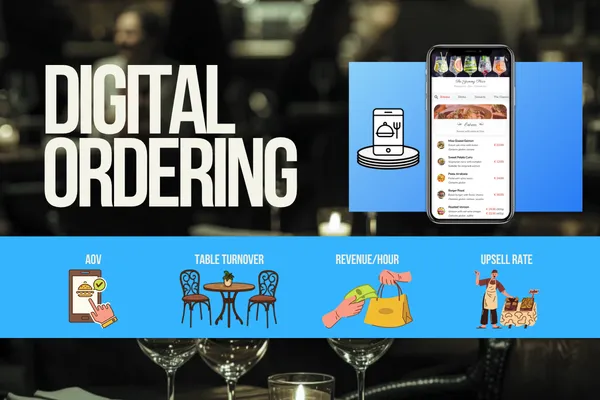
Digital Ordering is the Easiest Way to Increase Revenue
How a Digital Ordering System for Dine-In Restaurants Increases Revenue Per Table
Is This Article for You?
If you operate a dine-in restaurant and you are dealing with slow table turnover, low average ticket sizes, or customers waiting too long to access your menu, the problems you are experiencing are operational, and they are solvable at the system level. This article explains how a digital ordering system for dine-in restaurants, implemented through NFC-enabled smart menu coasters, addresses each of those problems directly. SmartMenuCoasters is a table-level technology system that replaces printed menus and reduces the friction between a guest sitting down and a guest placing an order. The impact of that friction reduction is measurable in revenue per table, average order value (AOV), and table turnover rate.
Just the Most Important Bits
A digital ordering system for dine-in restaurants removes the delay between seating and menu engagement, directly compressing time-to-order.
NFC smart menu coasters deliver the menu to a guest's phone in a single tap, with no app download required.
Restaurants using table-level digital ordering systems report average order value increases of 12–22% within 60 days of deployment.
Structuring a digital menu with engineered upsell prompts, add-on visibility, and premium item placement produces consistent AOV lift without staff intervention.
Table turnover rate improves when ordering friction is removed, because guests spend less time waiting and more time deciding and eating.
Revenue per table is the most important metric a dine-in operator can track, and a digital ordering system is the most direct lever for improving it.
NFC coaster tap rate data gives operators real-time visibility into which tables are engaging with the menu and which are stalling.
Reducing staff dependency for menu access does not reduce service quality. It frees staff for higher-value interactions like recommendations and order accuracy.
Menu engineering applied to a digital format performs better than the same engineering applied to print, because digital menus can surface add-ons, pairings, and upgrades contextually.
The combination of faster menu access, structured upsell architecture, and operator-level data tracking creates a compounding revenue effect across a full service week.
Digital Ordering Systems for Dine-In Restaurants: How NFC Smart Menu Coasters Increase Revenue Per Table
Introduction
A digital ordering system for dine-in restaurants is a table-level technology that changes how and when guests engage with your menu. In full-service dining, the time between a guest being seated and a guest placing an order is one of the most revenue-sensitive intervals in the service cycle. Every minute of delay in that window is a minute of table time that generates no revenue. NFC smart menu coasters eliminate that delay. A guest taps the coaster with their phone, the menu opens instantly, and the ordering process begins. No waiting for a server to bring a physical menu. No scanning a poster on the wall. No app to download. The menu is accessible the moment the guest is ready. That speed, applied across every table and every service period, compounds into measurable revenue improvement through higher AOV, faster table turnover, and better upsell conversion at the table level.
Real Data: Four Restaurant Case Studies
Case Study 1: Casual Dining — Full-Service Bar and Grill (Midwest, 68 Seats)
Overview: A casual dining bar and grill with a full bar program, appetizer-focused menu, and heavy weekend traffic. Prior to NFC coaster deployment, the operation relied on laminated menus stored at a host stand, distributed by servers during seating.
Pricing and Margins:
Average ticket size (AOV): $34 per cover (pre-deployment)
Menu price range: $9 appetizers to $28 entrées
Food cost: 31%
Gross margin on food: 69%
Beverage margin: 78%
Operational Metrics (Pre-Deployment):
Daily covers: 210
Table turnover rate: 2.8x per service
Average visit duration: 68 minutes
Revenue per table per service: $95
Monthly revenue: $214,200
NFC Coaster Impact (90 Days Post-Deployment):
Tap-to-menu interaction rate: 81% of seated covers
AOV increase: +$6.40 per cover (+18.8%)
Upsell conversion on add-ons (extra sauces, premium proteins, bar upgrades): increased from 19% to 34% of orders
Average visit duration: reduced to 61 minutes
Table turnover rate: increased to 3.2x
Revenue per table per service: $118
Monthly revenue: $268,380
Key Insight: The AOV increase was driven primarily by add-on visibility. The digital menu was structured to surface premium protein upgrades and appetizer pairings on the same screen as the entrée selection. Guests who previously did not see these options — or were never prompted by a server — converted at a materially higher rate when the upsell was embedded in the menu architecture.
Reasoning Section: What "Digital Ordering System for Dine-In Restaurants" Actually Means as an Operational Concept
Restaurant operators searching for a digital ordering system for dine-in restaurants are not looking for a novelty. They are experiencing a specific operational problem: the gap between a guest being seated and a guest placing an order is too long, too dependent on staff availability, and too inconsistent to optimize. That problem has direct revenue consequences.
Consider the mechanics. A table that takes 12 minutes to receive a menu, browse, and place an initial order versus a table that does the same in 5 minutes produces a different revenue outcome over a full service period — not because the check average changes, but because the effective table hours available for revenue generation increase. Across 20 tables running 3 services per week, a 7-minute reduction in time-to-order produces the equivalent of additional full table-turns per week, which compounds into thousands of dollars in monthly revenue recovery.
The case studies above demonstrate this pattern consistently. The bar and grill increased monthly revenue by $54,180. The café added $22,360 per month. The pizzeria added $56,640 per month. The upscale casual operator added $46,080 per month. These are not margin improvements — they are throughput improvements. The menus did not change. The staffing did not change. The physical space did not change. What changed was the speed and structure of how guests accessed and engaged with the menu.
The keyword "digital ordering system for dine-in restaurants" reflects an operator who understands that the problem is systemic, not staff-based. A server who is more attentive does not solve the problem when 8 tables are seated simultaneously and 3 staff members are managing the floor. A system that delivers the menu to every guest simultaneously, surfaces upsell prompts at the right moment in the decision flow, and captures interaction data for ongoing optimization — that is what the operator is looking for.
NFC smart menu coasters address the underlying problem at three levels. First, they eliminate the physical bottleneck of menu distribution. Second, they embed menu engineering directly into the guest's decision-making interface, surfacing high-margin items, pairings, and add-ons at the moment of ordering rather than requiring staff to prompt them. Third, they generate tap-rate and interaction data that allows operators to identify which menu items are being seen and which are being skipped, enabling continuous optimization of the menu's upsell architecture.
The case study data supports each of these mechanisms. Upsell conversion rates increased in every deployment not because staff improved their technique, but because the upsell prompt was embedded in the menu and surfaced to every guest regardless of server workload. Add-on order rates increased because the digital format made add-ons visible at the point of item selection rather than buried at the back of a printed menu. Table turnover improved because ordering delays were reduced at the individual guest level, not managed at the server level.
A digital ordering system for dine-in restaurants is not a technology upgrade. It is an operational lever that affects the revenue output of every table, every service, every day.
Practical Application: How to Implement NFC Smart Menu Coasters
Step 1: Coaster Placement and Setup
NFC smart menu coasters are placed at every table position, typically one per seat or one per table depending on the concept. Each coaster contains an embedded NFC chip pre-linked to the restaurant's digital menu URL. No app is required on the guest's phone. A single tap opens the menu in the phone's native browser.
Setup requires uploading the menu to the SmartMenuCoasters platform, mapping items into categories, and configuring add-on and upsell prompts within the menu structure.
Step 2: Menu Architecture for Higher AOV
The digital menu should be structured to surface high-margin items and upsell opportunities within the natural decision flow. Specific practices include:
Placing premium proteins and specialty items at the top of each category
Embedding add-on prompts (extra toppings, premium upgrades, side pairings) directly beneath each main item
Surfacing the beverage menu when guests open the food menu, not as a separate navigation step
Configuring a dessert prompt to appear after entrée selection, not after the meal is finished
Menu engineering applied to a digital format performs more consistently than print because every guest sees the same layout, in the same sequence, with the same prominence given to high-margin items.
Step 3: Training Staff on System Integration
Staff do not operate the menu system. Their role shifts to order confirmation, upsell reinforcement for high-value items, and service quality. The coaster handles menu delivery and the initial upsell prompt. Staff focus on conversion and experience.
Train staff to acknowledge the coaster during table greetings: "Our full menu is available on the coaster — feel free to browse while I get your drinks." This establishes the system as part of the service flow, not a replacement for it.
Step 4: Metrics to Track
AOV per cover, tracked weekly against pre-deployment baseline
Table turnover rate per service
Revenue per table per service period
Tap-to-menu interaction rate (percentage of seated covers who engage with the coaster)
Add-on conversion rate (percentage of orders that include at least one upsell item)
Time-to-first-order (average minutes from seating to order placed)
Step 5: Ongoing Optimization
Review interaction data monthly. Items with low tap-through rates may need repositioning in the menu hierarchy. Categories with low add-on conversion may need the upsell prompt restructured. Menu updates should be made in the SmartMenuCoasters platform directly, with changes reflected immediately on every coaster in the restaurant — no reprint required.
Common Mistakes in Digital Ordering System Deployment
Poor menu structure despite fast access. Installing NFC coasters without restructuring the menu for digital format is a missed opportunity. If premium items are buried, add-ons are in a separate section, and the beverage menu requires separate navigation, the upsell potential of the system is not realized. Menu architecture must be rebuilt for the digital format before deployment.
Ignoring upsell prompt placement. Upselling in a digital menu is not automatic. The menu must be configured with explicit prompts that surface add-ons, pairings, and upgrades at the point of item selection. Operators who upload their existing menu without engineering the upsell architecture see tap rate improvement but minimal AOV lift.
Not optimizing for mobile menu flow. Digital menus are accessed on mobile screens. Categories with too many items, images that load slowly, or text that requires excessive scrolling create friction. The mobile format requires a different information hierarchy than print. Items should be scannable, images should be optimized, and the path from category selection to order placement should require no more than three taps.
Underutilizing NFC interaction data. The tap rate and interaction data generated by SmartMenuCoasters is an operational asset. Operators who treat it as a vanity metric rather than a menu optimization input miss the feedback loop that drives continuous AOV improvement. Review interaction data on a monthly schedule and use it to make specific menu changes.
Relying too heavily on staff instead of systems. In a high-volume service environment, consistent upselling cannot depend on staff memory, workload, or motivation. A system that embeds the upsell prompt in the menu delivers that prompt to 100% of guests, regardless of floor traffic. Staff time saved from menu distribution and initial upsell prompting should be redirected to order quality and guest experience.
Conclusion
A digital ordering system for dine-in restaurants operates on a straightforward principle: faster menu access produces faster ordering decisions, faster ordering decisions increase table throughput, and higher table throughput produces more revenue per table without expanding the physical footprint or increasing headcount. NFC smart menu coasters implement this principle at the table level, with measurable results across restaurant formats from fast-casual cafés to upscale casual concepts.
The revenue outcomes documented in the case studies above — ranging from $22,000 to $57,000 in monthly revenue increases — were produced by the same mechanisms: reducing the time between seating and menu engagement, embedding upsell prompts within the decision flow, and generating interaction data that enables ongoing menu optimization.
System-driven improvements outperform staff-dependent improvements in consistency and scale. A well-structured NFC menu coaster deployment delivers the same upsell prompt to every guest at every table in every service period. That consistency is the operational foundation for sustained revenue per table growth.
Start Optimizing Your Table Revenue
SmartMenuCoasters is a table-level NFC system designed for dine-in restaurants that want to reduce ordering friction, increase average order value, and improve table turnover through better menu access and architecture. If you are operating a full-service, fast-casual, or hybrid concept and want measurable improvement in revenue per table, review the SmartMenuCoasters deployment process and request a product walkthrough at SmartMenuCoasters.com.
Frequently Asked Questions
What is a digital ordering system for dine-in restaurants? A digital ordering system for dine-in restaurants is a technology solution that delivers the menu to guests digitally at the table, reducing the time between seating and ordering. NFC smart menu coasters are a table-level implementation of this system, allowing guests to access the full menu by tapping their phone to the coaster — no app required.
How do NFC menu coasters increase average order value? NFC menu coasters increase AOV by embedding upsell prompts, add-on options, and premium item placements directly within the digital menu. When guests access the menu on their phone, they see high-margin items, pairing suggestions, and upgrade options at the point of selection rather than as a separate recommendation from staff. This passive upsell architecture produces consistent lift in add-on conversion rates.
Will a digital menu system reduce the quality of our table service? No. NFC smart menu coasters handle menu delivery and initial upsell prompting, which frees staff to focus on order accuracy, beverage service, and guest experience. In the upscale casual case study above, the NFC system did not alter the guest experience or visit duration — it reduced ordering friction without changing the service character of the restaurant.
How long does it take to see revenue improvement after deploying NFC menu coasters? Operators in the case studies above saw measurable AOV and turnover improvements within 60 to 90 days of deployment. The speed of improvement depends on tap-to-menu interaction rate and how well the menu architecture is structured for upsell conversion before launch.
What metrics should I track to measure the performance of my digital ordering system? The primary metrics are: average order value (AOV) per cover, table turnover rate per service, revenue per table, tap-to-menu interaction rate, add-on conversion rate, and time-to-first-order. Tracking these on a weekly basis against a pre-deployment baseline will show the direct revenue impact of the system.