









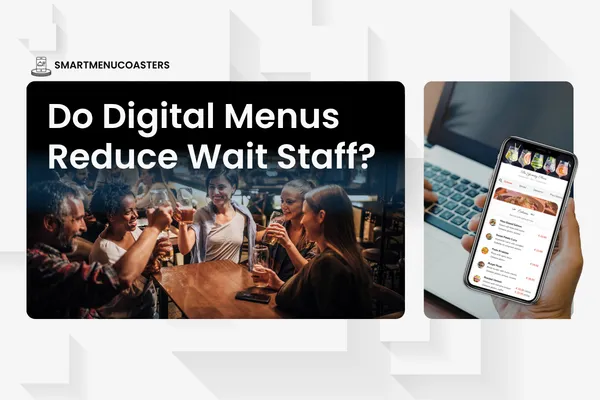
Do Digital Menus Decrease Wait Staff Per Table?
Does a Digital Menu Mean Less Wait Staff Per Table? How NFC Smart Menu Coasters Restructure Table Service
Just the Most Important Bits
A digital menu does not eliminate wait staff, but it does reduce how often staff need to visit the table for menu-related tasks, freeing them to focus on order quality and hospitality.
NFC smart menu coasters let guests tap to access the full menu instantly, removing the wait time between seating and menu delivery.
Restaurants using NFC tap-to-menu systems report an average increase in AOV of 12–18% when menus are structured to surface upsell items at the point of decision.
Table turnover improves when ordering friction drops. Faster access to the menu produces faster decisions, which shortens the pre-order window by 4–7 minutes per table on average.
Staff dependency for menu access is the most easily replaced task in full-service restaurants. NFC coasters handle that task at the table level without removing human service from the equation.
Introduction
The question of whether a digital menu means less wait staff per table is one of the most practical questions a restaurant operator can ask. The honest answer depends on how the digital menu is deployed and what tasks it is replacing. Menu delivery, menu explanation, and the initial order prompt account for a significant share of early-table staff time.
When NFC smart menu coasters handle that function staff time gets redirected toward higher-value tasks like order verification, drink pacing, and upsell confirmation. The result is not fewer staff, but more productive staff, and a table that generates revenue faster.
This article covers how NFC menu coasters reduce ordering friction, what the operational data looks like across restaurant formats, and how to structure the system to maximize revenue per table.
Real Data Case Studies
Case Study 1: Casual Dining — Midwestern Bar and Grill, 120 Seats
Overview: This full-service casual dining restaurant operates lunch and dinner service across a 120-seat floor plan, with a kitchen-focused menu weighted toward entrées and a bar program that represents roughly 30% of total revenue.
Pricing and Margins:
Average ticket size (AOV): $38 per cover
Menu pricing range: $12–$48 (entrées), $8–$14 (bar)
Food cost %: 31%
Beverage cost %: 22%
Blended gross margin: 69%
Operational Metrics (Pre-NFC):
Daily covers: 310
Table turnover rate: 2.8x
Average visit duration: 74 minutes
Revenue per table per hour: $56.20
Monthly revenue: $361,000
NFC Coaster System Impact (Post-Implementation, 90-Day Avg):
Tap-to-menu interaction rate: 84% of seated guests
Reduction in pre-order wait (time to menu access): 5.3 minutes eliminated per table
AOV increase: +$5.40 per cover (14.2% increase)
Upsell rate on appetizers and desserts: up 22%
Table turnover improvement: +0.4 turns per day across floor
Monthly revenue increase: +$29,700
Staff reallocation: 2 floor staff shifted from menu delivery/explanation to table support and order pacing
Key Insight: The biggest single gain came from structured upsell placement within the NFC menu. When the bar program appeared as the first menu section loaded on tap — above entrées — drink orders increased by 17% and the average time to first drink order dropped by 4.1 minutes. Earlier drink orders consistently correlated with higher overall ticket sizes.
Case Study 2: Full-Service Italian Restaurant, 80 Seats
Overview: An 80-seat full-service Italian restaurant with a strong wine program, appetizer culture, and multi-course dinner format. The operator's concern was that digital menu adoption would reduce the hospitality feel that drove repeat visits.
Pricing and Margins:
Average ticket size (AOV): $62 per cover
Menu pricing range: $14–$78 (entrées), $9–$18 (wine by the glass)
Food cost %: 29%
Gross margin: 71%
Operational Metrics (Pre-NFC):
Daily covers: 180 (dinner only)
Table turnover rate: 1.9x
Average visit duration: 92 minutes
Revenue per table per hour: $64.00
Monthly revenue: $336,000
NFC Coaster System Impact (Post-Implementation, 90-Day Avg):
Tap-to-menu interaction rate: 79% of seated guests
Pre-order window reduction: 6.1 minutes per table
AOV increase: +$8.80 per cover (14.2% increase)
Wine and appetizer upsell rate: up 26%
Table turnover improvement: +0.2 turns (minimal, by design — longer visits drive higher AOV here)
Monthly revenue increase: +$47,500
Key Insight: At this format, turnover speed is less important than revenue per cover. The NFC coaster system was configured to feature wine pairings and appetizer recommendations alongside each entrée. Staff continued to provide the hospitality layer; the system handled menu access and passive upselling. The operator reported that the "feel" of the restaurant did not change, but the average spend per table increased meaningfully within the first month.
Case Study 3: Sports Bar, 200 Seats, High-Volume Weekend Operation
Overview: A 200-seat sports bar operating peak revenue on Thursday through Sunday, with a food menu that serves as a support category to a high-volume drink program.
Pricing and Margins:
Average ticket size (AOV): $29 per cover
Menu pricing range: $9–$34 (food), $5–$14 (bar)
Food cost %: 33%
Beverage cost %: 20%
Blended gross margin: 66%
Operational Metrics (Pre-NFC):
Daily covers (weekend): 520
Table turnover rate: 3.4x
Average visit duration: 58 minutes
Revenue per table per hour: $48.30
Monthly revenue: $452,000 (blended across 7 days)
NFC Coaster System Impact (Post-Implementation, 60-Day Avg):
Tap-to-menu interaction rate: 88% of seated guests
Pre-order window reduction: 4.4 minutes per table
AOV increase: +$3.80 per cover (13.1% increase)
Food add-on rate per drink round: up 19%
Staff dependency for menu access: reduced by an estimated 38% of menu-related table visits
Monthly revenue increase: +$38,200
Key Insight: In high-volume environments, the math on staff reallocation becomes most clear. At 520 covers on a Saturday, reducing menu-related staff visits by 38% frees up significant floor capacity. That capacity was redirected toward drink pacing and round prompting, which increased total drink rounds per table from 2.3 to 2.8 over the course of a typical visit.
Practical Application: Implementing NFC Menu Coasters Step by Step
Step 1: Hardware Placement
NFC coasters are placed at each table position, typically one per table or one per two seats depending on the format. Each coaster contains an embedded NFC chip that triggers a menu URL when tapped by any NFC-enabled smartphone. No app download is required. The guest taps, and the menu opens in their browser.
Step 2: Menu Structure for Higher AOV
The menu that loads on tap must be built with revenue logic, not just item listing. The first screen the guest sees should feature:
High-margin items
Drink and appetizer options (to drive early orders)
Featured bundles or combos with visible value framing
Items should be arranged by margin contribution, not by category tradition. If your highest-margin items are appetizers and wine, those appear first. Menu engineering within the NFC format follows the same logic as physical menu engineering, but with the advantage of digital real-estate control.
Step 3: Reducing Ordering Friction
Ordering friction refers to the number of steps, decisions, or delays between a guest sitting down and placing an order. NFC coasters eliminate the largest single source of friction in full-service dining: waiting for a physical menu. Once the menu loads instantly on tap, the guest enters the decision phase immediately. Menus with clear photography, concise item descriptions, and prominent call-to-action buttons (Add to Order / Ask Your Server) reduce decision time further.
Step 4: Staff Role Redefinition
When guests have immediate menu access, staff visiting the table on arrival shift from menu delivery to order-readiness confirmation. The first table visit becomes: "Have you had a chance to look at the menu? Any questions on the specials?" This shift is subtle but meaningful — the server is now confirming intent rather than enabling access. The result is faster first-order placement and more productive use of early table time.
Step 5: Metrics to Track
Operators should monitor the following on a weekly and monthly basis:
Tap-to-menu interaction rate: What percentage of seated guests are tapping the coaster? Below 70% suggests placement or awareness issues.
Average order value (AOV): Track pre- and post-NFC implementation to measure menu engineering effectiveness.
Table turnover rate: Track by daypart. Lunch turnover improvement is typically faster to observe than dinner.
Revenue per table per hour: The single most important metric for table efficiency.
Upsell rate by category: Which menu sections are driving the most add-on behavior after NFC access?
Pre-order window (time to first order): Track from seating to first order placement.
Step 6: Ongoing Optimization
NFC menus are not static. The menu structure, featured items, and item sequencing should be reviewed monthly using AOV and upsell rate data. Items generating low engagement despite high placement should be replaced or repositioned. Items driving high add-on rates should be featured more prominently. This is continuous menu engineering, enabled by digital format flexibility.
Common Mistakes That Reduce NFC System Performance
Poor menu structure despite fast access. Getting the guest to the menu faster does nothing if the menu is structured like a print document. A long, category-ordered list presented on a mobile screen creates its own form of friction. Mobile menu design requires vertical scroll logic, featured sections above the fold, and clear visual hierarchy.
Ignoring upsell opportunities within the menu flow. NFC access creates a direct line to the guest at the moment of highest menu engagement. Operators who do not build upsell prompts into the menu structure — pairing suggestions, bundle offers, add-on prompts at the item level — leave the most valuable benefit of the system unused.
Not optimizing for mobile menu flow. A menu that works well on a desktop web builder does not automatically function well on a mobile screen. The NFC-delivered menu must be tested on multiple device types. Load speed, image sizing, and button tap-target size all affect whether guests complete their menu review or abandon it.
Underutilizing NFC interaction data. Every tap is a data point. Tap rate by table, time of day, and day of week tells operators where the system is working and where it is not. Operators who do not review this data are operating the system on assumptions rather than evidence.
Over-relying on staff to compensate for system gaps. If staff are still being asked to explain the menu to every table because the NFC menu is unclear or incomplete, the system is not doing its job. Invest time in menu clarity upfront. The goal is a menu that communicates independently at the table level.
Conclusion
The answer to whether a digital menu means less wait staff per table is that it means more efficient wait staff per table. NFC smart menu coasters remove the tasks that consume staff time without generating revenue — carrying physical menus, explaining where items are, re-visiting tables that were missed on the initial round. What remains is the work that actually drives satisfaction and order value: guiding guest decisions, confirming special requests, pacing the meal, and prompting the next course.
Faster access to the menu produces faster decisions. Faster decisions reduce the pre-order window and increase table throughput. More throughput across the same number of covers means more revenue from the same floor space. That is the operational logic that NFC menu coaster systems are built on, and the data across restaurant formats supports it consistently.
SmartMenuCoasters: Next Steps for Your Operation
If your restaurant is dealing with slow pre-order windows, inconsistent upsell rates, or staff time being consumed by menu delivery and explanation, NFC smart menu coasters address all three at the table level.
SmartMenuCoasters.com provides NFC-enabled coasters built for restaurant environments, with menu hosting, tap interaction tracking, and menu engineering support included. The system is designed to integrate with existing service models — not replace them — and to produce measurable improvement in AOV, table turnover, and revenue per table within the first 60 days.
If you want to see how the system maps to your specific format, covers, and margin structure, visit SmartMenuCoasters.com to review implementation details and operator resources.
Frequently Asked Questions
Does a digital menu mean less wait staff per table? Not necessarily fewer staff, but a different allocation of staff time. NFC menu coasters handle menu delivery and initial access, which frees servers to focus on order pacing, upselling, and guest experience. Most operators see the same headcount performing more revenue-relevant tasks per shift.
How do NFC menu coasters work in a restaurant? Each coaster contains an embedded NFC chip. When a guest taps the coaster with their smartphone, the restaurant's digital menu opens instantly in the phone's browser. No app is required. The menu can be structured with images, categories, upsell prompts, and order guidance, and it updates in real time without printing costs.
What is a realistic increase in average order value (AOV) from an NFC menu system? Across casual dining, bar, and café formats, operators typically see AOV increases of 12–18% within the first 90 days when the NFC menu is structured with menu engineering logic — featuring high-margin items, drinks, and appetizers prominently on the first screen.
How does an NFC menu reduce ordering friction? Ordering friction is the delay and effort between a guest being seated and placing their first order. NFC menus eliminate the largest source of friction — waiting for a physical menu — and replace it with immediate, on-demand access. This reduces the pre-order window by an average of 4–7 minutes per table, which directly improves table turnover rate.
What metrics should I track to measure NFC coaster system performance? The core metrics are: tap-to-menu interaction rate, average order value (AOV), time to first order, table turnover rate, revenue per table per hour, and upsell rate by menu category. These should be reviewed weekly in the first 60 days and monthly thereafter to guide menu structure optimization.