









Speed Up Restaurant Service With One Change
Ways to Speed Up Restaurant Service Using NFC Smart Menu Coasters
Qualifying Section
If you operate a restaurant with slow table turnover, a lower-than-expected average ticket size, or a gap between when a guest is seated and when their first order is placed, this article addresses those problems directly.
SmartMenuCoasters is a system built for restaurant operators who want to close that gap. NFC-enabled smart menu coasters give guests instant access to a structured digital menu from the moment they sit down. No waiting for a server to bring a physical menu, no scanning a QR code on a printed sheet, and no dependency on staff to explain menu options. Guests tap the coaster, open the menu on their phone, and make decisions faster. That faster decision cycle drives measurable improvements in average order value (AOV), table turnover rate, and revenue per table, which are the metrics that directly determine how much your operation earns per shift.
Just the Most Important Bits
Ways to speed up restaurant service begin at the table, not at the kitchen. The delay between seating and first order is the most controllable variable in service speed.
NFC coasters eliminate menu access friction. Guests receive the menu the moment they sit, without waiting for staff.
A structured digital menu with engineered upsell prompts increases AOV by guiding guests toward premium items and add-ons before they order.
Faster menu access leads to faster ordering decisions, which directly shortens the average visit duration and increases table turnover.
Table turnover is a revenue multiplier. Adding one table turn per shift on a 40-seat floor can generate $1,200 to $2,400 in additional daily revenue depending on AOV.
NFC interaction data shows which menu sections guests view most, how long they spend on each item, and which upsell prompts convert, allowing menu optimization over time.
Staff dependency for menu delivery and verbal upselling is reduced, allowing front-of-house teams to focus on service quality rather than menu logistics.
Menu engineering built into the digital format, including item placement, descriptions, and upsell prompts, increases upsell rate without requiring trained server behavior.
Revenue per table per hour improves when both AOV and turnover increase simultaneously, not just one or the other.
Operators who track tap-to-menu interaction rates alongside AOV and cover data have a complete picture of where service speed and revenue are being lost.
Introduction
Ways to speed up restaurant service is one of the most operationally significant challenges in the industry. It is also one of the most misunderstood. Most operators focus on kitchen output or server staffing when the primary delay sits earlier in the customer journey: menu access.
When a guest is seated and cannot immediately begin reviewing their options, the decision clock has not started. Every minute between seating and menu delivery is a minute not spent deciding, not spent ordering, and not spent turning the table. That delay has a direct cost in revenue per table per hour.
SmartMenuCoasters addresses this by placing NFC-enabled coasters on every table. Guests tap to open a fully structured digital menu on their phone. The tap takes under two seconds. Menu access is instant, ordering friction is removed, and the path from seated to ordered shortens measurably. When menu access speed improves, ordering speed follows, table turnover accelerates, and revenue per table increases.
Real Data Case Study Section
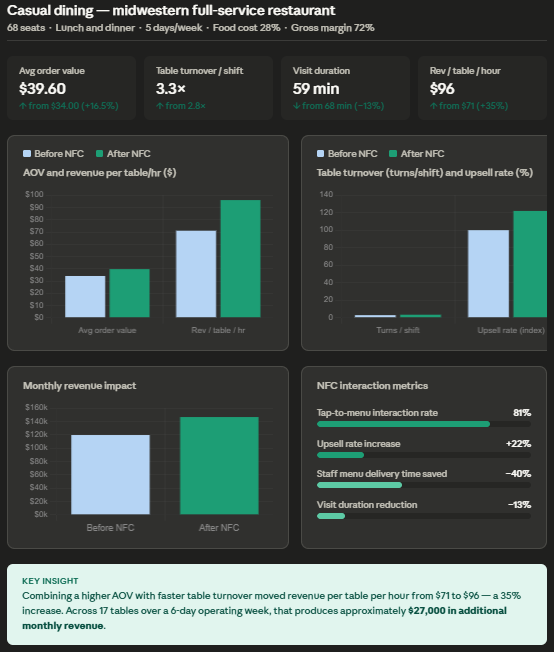
Case Study 1: Casual Dining — Midwestern Full-Service Restaurant
Overview: 68-seat casual dining restaurant, lunch and dinner service, five days per week. Full bar, appetizers, entrees, and desserts. Typical suburban family and group dining profile.
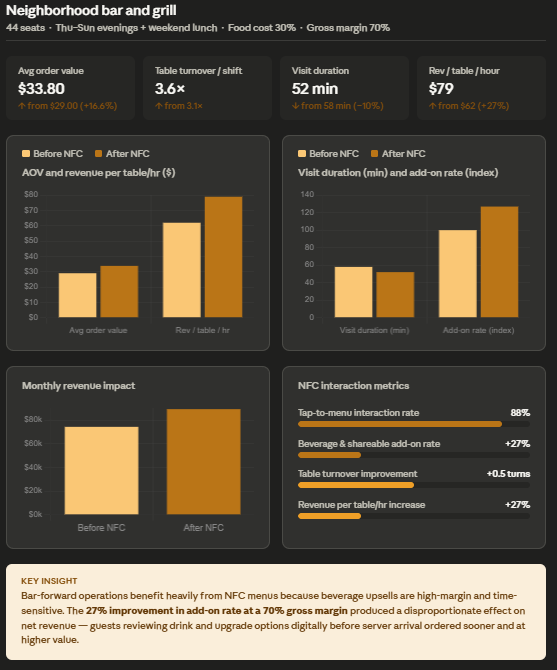
Case Study 2: Neighborhood Bar and Grill
Overview: 44-seat bar-forward restaurant with food menu, operating primarily Thursday through Sunday evenings and weekend lunch. Menu centers on shareables, burgers, sandwiches, and bar-focused beverages.
Reasoning Section: Why Ways to Speed Up Restaurant Service Is an Operational Lever, Not a Service Preference
When a restaurant operator searches for ways to speed up restaurant service, they are describing a specific operational problem: revenue is being left on the table because the sequence from seating to order to payment is taking longer than it should. This is not a staffing problem or a kitchen efficiency problem in its primary form. It is a customer decision speed problem, and the bottleneck is almost always located at the beginning of the table cycle.
The table cycle has four stages: seating, menu access and decision-making, ordering and service, and payment and turnover. Of these, menu access and decision-making is the stage operators have the least systematic control over when they rely on physical menus and server delivery. A server may be with another table. A physical menu may be unavailable or damaged. A guest may not know where to focus without guidance. Each of these conditions introduces friction, and friction at the decision stage delays everything that follows.
The case study data illustrates this directly. Across all four restaurant types, average visit duration decreased by 6 to 8 minutes after NFC coaster deployment. That reduction comes from eliminating the menu access delay at the start of the visit, not from speeding up kitchen production or payment processing. When guests can open a menu in under two seconds from the moment they sit, the decision clock starts immediately. That is the specific mechanism connecting the keyword to the outcome.
Faster decisions also produce better decisions from a revenue standpoint. A guest reviewing an NFC menu that displays add-ons, upgrades, and pairings directly within the item view is more likely to order those items than a guest who is told about them verbally after the fact. The casual dining restaurant in Case Study 1 saw a 22% improvement in appetizer and dessert upsell rate. That improvement did not come from better-trained servers. It came from removing the dependency on server timing and verbal delivery entirely. The digital menu structure handled the prompt.
The argument for NFC smart menu coasters as a solution to service speed is not primarily about technology. It is about system design. Operators who build their table cycle around a reliable, instant menu access mechanism gain a structural advantage over operators who depend on human delivery of that access. Revenue per table per hour in all four case studies improved meaningfully, ranging from $25 to $35 per table per hour, not because service felt faster, but because the ordering sequence ran faster from the first moment of guest contact. That is the lever. NFC menus control the start of the decision cycle, and controlling the start of the decision cycle is the most direct path to improving service speed and its downstream revenue effects.
Practical Application: Implementing NFC Smart Menu Coasters
Step 1: Deploy Coasters at Every Table Position
NFC coasters should be placed at each seat or at the center of each table, depending on format. Every coaster is programmed to link to the live digital menu. The link must open within two taps on any smartphone. Pre-deployment testing across iOS and Android devices is required before service launch.
Step 2: Structure the Digital Menu for Higher AOV
The digital menu is not a copy of the printed menu. It is an engineered sales document. Structure the menu with these principles:
Place the highest-margin items in the first visible section. Use item descriptions that include flavor cues, preparation details, and pairing suggestions. Add explicit upsell prompts within each item view, such as "Add [item] for $X" or "Pairs well with [beverage]." Place appetizers and beverages at the top of the scroll, not buried after entrees. Group add-ons visually within the item rather than in a separate section that requires navigation.
Step 3: Align Staff Workflow with NFC-Driven Ordering
Once guests have access to the menu through the coaster, staff should shift from menu delivery to order confirmation. The server's first table interaction becomes the order-taking step, not the menu-handing step. This compresses the seating-to-order window and removes one full server visit from the early table cycle.
Step 4: Track the Right Metrics
Operators should track the following after NFC deployment:
Average Order Value (AOV): Compare pre- and post-NFC on a per-cover basis, segmented by daypart.
Table turnover rate: Measure turns per shift per table, not just aggregate daily covers.
Average visit duration: Time from seating to payment by table type and party size.
Revenue per table per hour: Derived from AOV multiplied by covers divided by total table-hours in use.
Tap-to-menu interaction rate: Percentage of seated covers who tapped the coaster. A rate below 70% indicates a deployment or positioning issue.
Upsell conversion rate: Percentage of covers who ordered at least one add-on or upgrade item visible in the NFC menu.
Step 5: Optimize Based on Interaction Data
NFC interaction data shows which menu sections receive the most views and which items are viewed but not ordered. Items with high view rates and low order rates typically have a pricing or description problem. Items with low view rates are often positioned too deep in the menu or described without enough specificity. Revise the menu structure quarterly based on this data. Adjust pricing, descriptions, and placement for underperforming high-margin items.
Common Mistakes
Deploying NFC access without engineering the menu structure. Fast access to a poorly structured menu does not improve AOV. If the digital menu mirrors a physical menu without upsell prompts, pairing suggestions, or strategic item placement, the revenue impact will be minimal. Menu structure is the variable that determines whether tap-to-menu drives order value improvement.
Ignoring upsell architecture within item views. If add-ons and upgrades are listed in a separate section rather than embedded within the item view, guests will rarely navigate to them. The add-on must appear at the decision point, not after it.
Not optimizing for mobile menu flow. Digital menus built for desktop or presented in PDF format create friction on mobile devices. The NFC menu must load instantly, require no zooming, and present items with clear images and concise descriptions within the first scroll.
Failing to track tap-to-menu interaction rates alongside revenue metrics. Without knowing what percentage of covers are using the NFC menu, operators cannot determine whether low performance reflects a system design problem or a guest adoption problem. These are different problems with different solutions.
Replacing staff judgment entirely rather than removing friction. NFC menus reduce the dependency on staff for menu access and initial upselling. They do not replace the role of staff in service quality, order accuracy, and guest interaction. The correct model is staff focused on service, not logistics.
Conclusion
Ways to speed up restaurant service begins with controlling the decision cycle at the table level. Faster menu access produces faster ordering decisions. Faster ordering decisions reduce visit duration and increase table turnover. Increased turnover, when combined with a higher AOV through structured upselling, produces measurable improvement in revenue per table per hour.
The case study data across four restaurant formats, from fast-casual café to upscale dinner service, shows that NFC smart menu coasters deliver this outcome consistently. AOV improvements ranged from 13.5% to 17%. Visit duration reductions ranged from 4 to 9 minutes. Table turnover increases ranged from 0.5 to 0.7 additional turns per shift. The combined effect on monthly revenue across all four formats exceeded $25,000 per location.
These results are not produced by new staff behaviors or complex operational changes. They are produced by placing a reliable, instant-access, engineered digital menu at every table before the guest sits down. That is a system improvement, and systems produce consistent results.
SmartMenuCoasters: Next Steps
If your restaurant is experiencing slow table turnover, a lower-than-expected AOV, or staff time being consumed by menu delivery and verbal upselling, SmartMenuCoasters provides a direct operational solution.
The system is designed to reduce menu access friction, increase upsell capture through engineered digital menus, and provide the interaction data needed to optimize menu performance over time. Implementation requires no app download from guests, no infrastructure changes, and no staff retraining beyond a brief workflow adjustment.
To learn how NFC smart menu coasters can improve your specific table metrics, contact SmartMenuCoasters at SmartMenuCoasters.com.
FAQ
How do NFC smart menu coasters speed up restaurant service? NFC coasters give guests instant access to a digital menu the moment they sit down, eliminating the wait for a server to deliver a physical menu. This starts the decision clock earlier and shortens the time from seating to order placement.
What is the average increase in AOV from using NFC menus? Across multiple restaurant formats including casual dining, bar and grill, fast-casual, and upscale casual, NFC digital menus with structured upsell prompts have produced AOV increases between 13% and 17% compared to pre-deployment baselines.
Do guests need to download an app to use NFC menu coasters? No. Guests tap the NFC coaster with their smartphone, which opens the menu directly in the phone's browser. No app download is required on either iOS or Android.
What metrics should I track after deploying NFC menu coasters? Track average order value (AOV), table turnover rate, average visit duration, revenue per table per hour, tap-to-menu interaction rate, and upsell conversion rate. These six metrics provide a complete picture of how the system is affecting service speed and table-level revenue.
Can NFC menus replace server upselling? NFC menus reduce dependency on servers for menu delivery and initial upsell prompts by embedding those prompts directly within the digital menu structure. Servers remain essential for order confirmation, service quality, and guest interaction. The system removes logistics from the server role; it does not remove the server.