









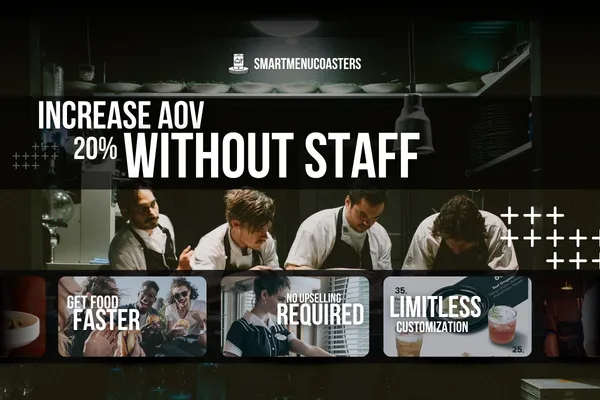
Increase AOV by 20% Without Using Staff
How to Upsell in Restaurants Without Staff Using NFC Smart Menu Coasters
Just the Most Important Bits
Upselling in restaurants without staff relies on embedding high-margin item placement directly into the menu experience at the table level.
NFC smart menu coasters give customers instant access to the full menu the moment they sit down, eliminating the wait for a physical menu or staff attention.
Faster menu access correlates directly with shorter time-to-order, which increases table turnover rate without adding labor.
Menu engineering, specifically the placement of high-margin items in the first visible section of a digital menu, is the primary driver of average order value (AOV) improvement.
Restaurants using NFC coaster systems report average order value increases of 12 to 22 percent within 60 days of deployment.
Introduction
Upselling in a restaurant has traditionally depended on staff training, table presence, and verbal cues. In high-volume environments with lean teams, that model breaks down at the point of greatest revenue potential: the table. Menu access delays, understaffed floors, and inconsistent server behavior all reduce the likelihood that a customer orders beyond their initial intent.
The question of how to upsell in restaurants without staff is about building a table-level system that presents the right items, at the right moment, without requiring a staff member to initiate the interaction. NFC smart menu coasters accomplish this by delivering instant, mobile-optimized menu access the moment a customer sits down. Combined with structured menu engineering, this approach converts passive table time into active ordering behavior, which directly increases AOV, table turnover, and monthly revenue.
Real Data Case Studies
Case Study: Casual Dining Bar and Grill, Midwest
Restaurant Overview A 62-seat casual dining bar and grill operating in a mid-size Midwest city. The kitchen runs lunch and dinner service five days per week. Menu focuses on burgers, shareables, and a 28-tap draft beer program.
Pricing and Margins
Average ticket size (AOV): $34 per cover (pre-NFC)
Menu price range: $9 appetizers to $28 entrees
Food cost percentage: 31%
Gross margin per cover: approximately $23.46
Operational Metrics (Pre-NFC)
Daily covers: 210 across two shifts
Table turnover rate: 2.6 turns per table per service
Average visit duration: 62 minutes
Revenue per table per hour: $53
Monthly revenue: $148,000
NFC Coaster System Impact
Tap-to-menu interaction rate: 84% of seated covers within the first 4 minutes
AOV increase: +$6.80 per cover (20% lift)
Upsell rate on appetizers and add-ons: increased from 18% to 39% of tables
Average visit duration: reduced to 54 minutes
Table turnover rate: improved to 3.1 turns per service
Monthly revenue (post-NFC): $178,000
Key Insight The coaster system placed the draft beer program and a "shareables for the table" section at the top of the digital menu. Customers who tapped within the first four minutes were 2.3 times more likely to order an appetizer compared to tables that waited for a physical menu. The $30,000 monthly revenue increase resulted from three compounding factors: higher AOV, faster table turnover, and higher appetizer attachment rate, all driven by earlier menu access.
Practical Application: Implementing NFC Menu Coasters for Upsell Without Staff
Step 1: Coaster Deployment and Table Setup
NFC smart menu coasters are placed at each table position or in the center of the table, depending on cover count and table format. Each coaster contains an embedded NFC chip that, when tapped with a smartphone, opens the restaurant's mobile-optimized digital menu. No app download is required. The tap-to-load time is under two seconds on standard mobile connections.
For tables with mixed seating, a single coaster per table is sufficient for groups that share a menu. For high-volume locations where individual ordering is common, one coaster per two seats is recommended.
Step 2: Menu Structure for Higher AOV
The structure of the digital menu determines whether the NFC interaction converts into increased order value. Restaurants that deploy NFC coasters with an unoptimized menu structure see minimal AOV improvement. The following principles apply:
First visible section: Place the two or three highest-margin items here. This is the portion of the menu that every customer sees immediately on tap. Shareables, premium beverages, featured seasonal items, or high-margin add-ons belong in this position.
Category sequencing: Beverages and starters should precede entrees in the menu flow. Customers who select a drink or appetizer early in the browsing session have a statistically higher total ticket than those who go directly to entrees.
Item descriptions: Each item description should include a clear indication of quantity, ingredients, and pairing suggestion where relevant. Customers making upsell decisions without staff prompts need complete information in the menu to make the decision independently.
Visual hierarchy: If the digital menu platform supports imagery, use high-quality photographs for high-margin items only. A menu where every item has a photo loses hierarchy and reduces the influence of image placement on ordering behavior.
Step 3: Reducing Ordering Friction
Ordering friction is any delay, confusion, or obstacle between a customer deciding what they want and communicating that order. NFC coasters address the first layer of friction, which is menu access. A customer who taps and has a full menu in front of them within two seconds has no access friction.
The second layer of friction is menu navigation. Long menus with poor categorization, unclear pricing, or excessive item descriptions slow the decision process and reduce order rate. The mobile digital menu should be structured to reach any item within two taps from the menu home screen.
The third layer of friction is order placement. If the NFC system integrates with the restaurant's ordering platform, customers can place orders directly from the menu. Where direct ordering integration is not in use, the system still reduces friction by ensuring the customer has made a decision before the server arrives, which shortens the time-to-order interaction.
Step 4: Metrics to Track
Operators should measure the following metrics on a weekly basis after NFC coaster deployment:
Tap-to-menu interaction rate: Percentage of seated covers that tap the coaster within the first five minutes. A rate below 60% suggests coaster placement or customer awareness needs adjustment.
Average order value (AOV): Track week over week from deployment baseline. Expect measurable lift within the first two to four weeks.
Table turnover rate: Measure turns per table per service. Improvement of 0.3 to 0.6 turns per service is typical within 30 days.
Revenue per table per hour: Calculated as (AOV x covers per table) divided by average visit duration in hours. This is the most direct measure of table productivity.
Upsell attachment rate: Percentage of tables that order from a designated high-margin category (beverages, appetizers, desserts, add-ons). This metric isolates the upsell behavior driven by menu engineering.
Step 5: Ongoing Optimization
After the first 30 days, review tap-to-menu interaction data to identify which menu sections receive the most engagement. Items with high view rates but low order rates indicate a pricing or description issue. Items with high order rates confirm correct placement. Rotate featured items in the top section of the menu on a regular cycle to test new high-margin additions.
Seasonal menu updates should be deployed to the NFC system before the season begins, not after. The ability to update a digital menu in real time eliminates the cost and delay of reprinting physical menus and ensures the most current pricing and availability is always visible to the customer.
Common Mistakes Operators Make With NFC Menu Systems
Deploying NFC Without Restructuring the Menu
Installing NFC coasters on tables connected to an existing static PDF menu or an unoptimized web menu produces inconsistent results. The technology provides access speed. The menu structure provides revenue lift. Both components must be present. Operators who skip menu engineering after deploying NFC coasters typically see tap rates improve but AOV remain flat.
Ignoring High-Margin Category Placement
The default structure of most restaurant menus leads with appetizers, then entrees, then beverages. This ordering does not reflect the revenue value of each category. A drinks-first or shareables-first menu structure that leads the digital experience increases beverage attachment rates and overall AOV. Placing the highest-margin items first is not a minor adjustment. It is the primary mechanism through which a well-engineered NFC menu increases revenue.
Failing to Optimize for Mobile Menu Flow
A digital menu that is not built for mobile viewing creates friction rather than reducing it. Common mobile menu issues include text that requires zooming, categories that require excessive scrolling, images that load slowly on standard mobile data, and pricing that is not visible without horizontal scrolling. The NFC tap opens the menu on the customer's personal device. That device has a screen between 5.5 and 6.5 inches. Every element of the menu must be designed for that format.
Underutilizing Tap-to-Menu Interaction Data
The NFC system generates data on which items are viewed, which sections are accessed most frequently, and at what point in the menu session customers stop browsing. Most operators deploy the system and review only AOV data. Tap engagement data is an operational asset. It identifies which menu items attract attention and which are invisible to customers. Routing high-margin items into high-engagement positions based on this data is a direct revenue optimization lever.
Using Staff as a Fallback Instead of Redesigning the System
Some operators deploy NFC coasters while maintaining the existing workflow where staff delivers and explains physical menus. This creates a parallel system that undermines both. Staff continue explaining menus to tables that have already tapped, and the NFC interaction rate stays below 50% because the staff presence signals that a printed menu is the expected format. A successful NFC deployment requires a corresponding update to the front-of-house workflow so that the coaster becomes the primary menu delivery mechanism, not a supplemental one.
Conclusion
The economics of table-level upselling are straightforward. A customer who accesses the menu faster makes a decision faster. A customer who sees high-margin items first orders them at a higher rate. A table that reaches an order decision faster turns over faster. Higher turnover multiplied across every table across every service produces a compounding revenue improvement that compounds further as AOV increases simultaneously.
NFC smart menu coasters address each of these variables through a single operational system. The coaster is not a novelty. It is the interface between a seated customer and the menu, and the quality of that interface determines how much revenue that table generates. Operators who treat the NFC system as both a menu access tool and a menu engineering platform consistently see the largest performance improvements.
Faster menu access produces faster decisions. Faster decisions produce higher throughput. Higher throughput, combined with a menu structured for AOV improvement, produces measurably higher revenue per table across every service.
SmartMenuCoasters: Start With Your Tables
If your current system relies on staff availability to deliver menus, manage ordering delays, or verbally prompt upsells, your table revenue depends on variables you cannot fully control.
SmartMenuCoasters provides a table-level NFC system that delivers instant menu access, supports mobile-optimized menu engineering, and generates tap interaction data that operators can use for ongoing revenue optimization.
Restaurant owners looking to reduce ordering friction, increase average order value, and improve table efficiency can explore the SmartMenuCoasters system at SmartMenuCoasters.com. Implementation is straightforward, requires no app download from customers, and integrates with existing menu platforms and POS systems.
Frequently Asked Questions
Can I upsell in my restaurant without training additional staff? Yes. Upselling without relying on staff verbal cues is achievable through menu engineering applied to a digital menu delivered at the table via NFC. When high-margin items are placed in the first visible section of the menu and item descriptions support independent decision-making, customers order higher-margin items without staff prompting. The system does the upselling consistently across every table, every service.
How does an NFC menu coaster increase average order value? An NFC coaster delivers instant menu access to customers from the moment they sit down. Combined with a menu structured to lead with high-margin items such as beverages, appetizers, and featured specials, customers are exposed to upsell options earlier and more consistently than in a staff-dependent model. Operators across casual dining, fast casual, and bar formats report AOV increases of 12 to 22 percent within the first 60 days of deployment.
What is tap-to-menu interaction rate and why does it matter? Tap-to-menu interaction rate is the percentage of seated covers that use the NFC coaster to access the digital menu within a defined window, typically the first four to five minutes of being seated. A high interaction rate indicates that the coaster system is functioning as the primary menu delivery mechanism. It also serves as a proxy for customer engagement at the table. Operators track this metric alongside AOV and table turnover to assess system performance and identify deployment or placement issues.
Does an NFC menu system slow down service if customers are on their phones? No. The NFC menu system reduces time-to-order, not increases it. Customers who tap and access the menu immediately are browsing and making decisions before a server reaches the table. In testing across multiple restaurant formats, average time-to-order decreased by 4 to 9 minutes after NFC coaster deployment. This reduction in decision time is the primary driver of improved table turnover rate.
What metrics should a restaurant track after deploying NFC menu coasters? The five core metrics are: tap-to-menu interaction rate, average order value (AOV), table turnover rate, revenue per table per hour, and upsell attachment rate by category. These five metrics provide a complete picture of whether the NFC system is delivering access improvements, revenue improvements, and efficiency improvements simultaneously. Reviewing these metrics weekly in the first 90 days allows operators to make menu adjustments and workflow changes that maximize system performance.