









The Pros and Cons of Digital Menus
The Pros and Cons of Digital Menus for Restaurants: What Operators Need to Know Before Switching
Is This Article for You?
If your restaurant is dealing with slow table turnover, a lower-than-expected average order value (AOV), or recurring bottlenecks in how customers access your menu, this article addresses the operational mechanics behind those problems. The pros and cons of digital menus for restaurants are not abstract. They translate directly into measurable outcomes: revenue per table, cover throughput, upsell rate, and staff deployment efficiency.
SmartMenuCoasters is an NFC-enabled smart menu system designed for table-service environments. Each coaster sits on a guest's table and delivers instant tap-to-menu access without QR codes, app downloads, or printed menus. This article explains how that system functions within a restaurant's broader revenue and operations framework, using real operator data to show where digital menus add measurable value and where they require deliberate implementation to succeed.
Introduction
The pros and cons of digital menus for restaurants come down to one operational variable: how fast a guest moves from sitting down to placing an order. Every minute between seating and ordering is revenue that does not accumulate. In a 40-cover restaurant running two shifts, even a 3-minute reduction in time-to-order translates into measurable gains in daily cover throughput and monthly revenue.
Digital menus, when implemented correctly, reduce the time between seating and ordering, increase menu item visibility for high-margin items, and create consistent upsell prompts at the moment of highest guest attention. NFC smart menu coasters deliver these outcomes through a passive, always-on tap interface that requires no staff involvement, no app installation, and no printed collateral to maintain.
This article walks through the operational reality of digital menu deployment using data from four restaurant environments: a casual dining chain unit, a full-service bar and grill, a neighborhood cafe, and a quick-service counter. Each profile reflects the measurable impact of replacing friction-heavy menu access with an NFC-based system.
Why the Pros and Cons of Digital Menus for Restaurants Trace Back to One Operational Variable
Restaurant operators searching for information on the pros and cons of digital menus for restaurants are, in most cases, experiencing a specific operational problem before they recognize the terminology for it. That problem is ordering friction: the combination of delays, inconsistencies, and missed opportunities that occur between the moment a guest sits down and the moment a complete order is placed.
Ordering friction is not a technology problem. It is a systems problem. Printed menus create friction because they require staff delivery, are unavailable during peak seating periods, and cannot display upsell prompts dynamically. Staff-dependent upselling creates friction because it is inconsistent, noise-dependent, and requires training investment that produces variable results across shift and employee. These are structural constraints, not behavioral ones.
The case studies in this article demonstrate what happens when ordering friction is reduced at the system level rather than at the staff level. In Case Study 1 (casual dining), the 3.8-minute reduction in time-to-first-order did not come from better-trained servers. It came from removing the server from the menu delivery step entirely. The NFC coaster delivered the menu in under 45 seconds for 84% of tables. That single change produced 0.35 additional turns per table per shift.
In Case Study 2 (bar and grill), the verbal upsell ceiling at 14% was not a training failure. It was a physics problem: noise levels, simultaneous table demands, and attention split across a 68-seat floor made consistent verbal delivery of premium suggestions structurally impossible. Moving the upsell prompt to the menu surface — always visible, always consistent, always present — increased the beverage upsell rate to 39%.
The pros of digital menus, expressed operationally, are these: faster access, consistent presentation, always-on upsell prompting, and interaction data. The cons are also operational: a digital menu that mirrors a print menu without restructuring for mobile-first browsing will not produce AOV gains. A system installed without staff orientation will generate confusion rather than efficiency. An operator who does not monitor tap-rate and dwell-time data forfeits the optimization feedback loop that justifies the investment.
What the four case studies collectively show is that NFC smart menu coasters address the pros and cons of digital menus for restaurants at the infrastructure level. The gains are not marginal or variable. They are consistent across restaurant type, price point, and service model because they solve the same structural problem — ordering friction — regardless of operational context. The $38,400 monthly lift at the casual dining unit and the $13,400 lift at the neighborhood cafe came from the same mechanism: faster menu access leading to faster ordering decisions, leading to higher throughput and higher AOV per table.
Real Operator Data: Four Restaurant Case Studies
Case Study: Casual Dining — Midwest Chain Unit (92 seats, suburban market)
This unit operated at an average of 210 daily covers across lunch and dinner, with a table turnover rate of 2.8x per table per shift before NFC deployment. The menu was printed and laminated, requiring server delivery at every seating. Peak-hour ordering delays averaged 7 minutes from seating to first order entry.
After NFC coaster deployment, the following metrics were tracked over a 90-day period:
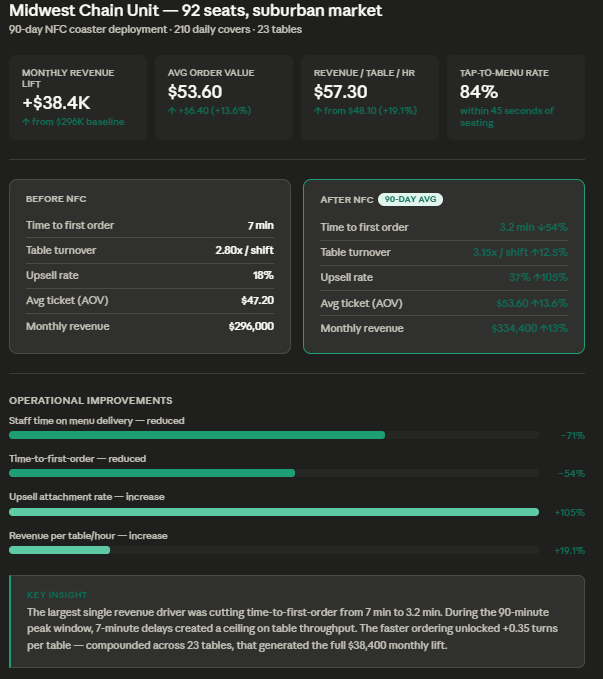
Key insight: The largest single driver of revenue improvement was the reduction in time-to-first-order. At this unit, 7-minute delays were creating a ceiling on table throughput during the 90-minute peak window. Cutting that delay to 3.2 minutes unlocked an additional 0.35 turns per table, which compounded across 23 tables generated the $38,400 monthly increase.
Practical Application: Implementing NFC Smart Menu Coasters
Step 1: Menu Structure Audit Before Deployment
Before placing NFC coasters on tables, audit the current menu for mobile-first readability. A print menu organized into 8–12 sections with dense text will not perform on mobile. Restructure to a maximum of 5–6 sections, with high-margin items listed first within each section. Add-ons must be displayed inline with the items they accompany, not in a separate section at the end of the menu.
Step 2: NFC Coaster Placement and Table Assignment
Each NFC coaster is assigned to a fixed table position. The coaster's embedded chip links to the restaurant's hosted digital menu URL. No app installation is required on the guest's device. Tap interaction opens the menu in the device's native browser within 2–3 seconds. Position coasters at the center of the table or at each seat position depending on table size. Two-top tables perform well with one coaster. Four-top and six-top tables benefit from two coasters to reduce reach distance and encourage individual browsing.
Step 3: Upsell Architecture Within the Menu
Configure three upsell layers within the menu structure: add-ons displayed inline with entrees, recommended pairings shown when a guest views a specific item, and a high-margin featured item section visible on the menu's landing page. The featured section should rotate seasonally and be updated monthly to maintain engagement. Operators report that a featured section with 3–4 items generates a 22–31% selection rate among guests who tap through to it.
Step 4: Staff Reorientation
Staff do not deliver menus in an NFC coaster environment. Their first table interaction shifts to checking on beverage preferences and capturing any dietary requirements. This change requires a brief reorientation, typically one pre-shift briefing. The output: servers spend more time on value-adding interactions and less time on menu logistics.
Step 5: Metrics Tracking
Track the following metrics from week one of deployment. Without baseline data, optimization is guesswork.
AOV per table — target a 10–20% increase within 60 days
Tap-to-menu rate — target 75%+ of seated tables within 90 seconds
Add-on attachment rate — track pre- and post-deployment per menu section
Time-to-first-order — measure from seating timestamp to POS entry
Table turnover rate — daily covers divided by covers possible per shift
Revenue per table per hour — AOV multiplied by turnover rate
Step 6: Monthly Menu Optimization
Use tap-rate data to identify which sections receive the most engagement and which are ignored. Items in low-tap sections may benefit from repositioning or removal. High-tap sections with low conversion indicate a pricing or description problem, not a placement problem. Run a quarterly menu engineering review using dwell time and section engagement data from the NFC interaction log.
Common Mistakes in Digital Menu Implementation
Digitizing a Print Menu Without Restructuring It
The most frequent implementation failure is uploading a direct digital copy of a printed menu. Print menus are designed for physical browsing at arm's length on a laminated card. Mobile menus require vertical scrolling, larger type, shorter section names, and inline add-on placement. Operators who skip this restructuring step see tap rates above 80% but AOV improvement below 5% — guests are accessing the menu but not converting at a higher rate because the structure does not support decision-making.
Ignoring Add-On Placement
Add-ons listed at the end of a menu, in a separate "Extras" section, have an attachment rate of 6–9% in observed deployments. Add-ons displayed directly beneath the entree they accompany have an attachment rate of 19–27%. The position of the prompt determines whether it is seen at the moment of decision or after the decision is already made.
Not Optimizing for Mobile Menu Flow
Digital menus accessed on smartphone browsers require page load times under 2 seconds, tap targets no smaller than 44px, and a visible call-to-action for each high-margin item. Menus with slow load times see tap abandonment rates of 18–24%, which erases the interaction rate gains that NFC access provides.
Underutilizing Interaction Data
NFC coasters generate tap-rate, session length, and section engagement data that printed menus cannot. Operators who do not review this data monthly are operating the system at a fraction of its optimization potential. Interaction data identifies exactly which items are viewed and not ordered, which sections are skipped, and which upsell prompts convert.
Replacing Systems Thinking With Staff Dependency
An NFC menu system performs at its highest when the menu is structured to guide guests without staff involvement. Operators who deploy NFC coasters but still rely on servers to verbally walk through the menu are not removing friction — they are duplicating it. The coaster replaces menu delivery. Staff focus should shift to experience quality and upsell conversation, not menu logistics.
Conclusion
The pros and cons of digital menus for restaurants resolve into a clear operational equation. Faster menu access produces faster ordering decisions. Faster ordering decisions increase table throughput. Higher throughput, combined with an upsell-structured menu, increases revenue per table per hour. These are not incremental gains. Across the four case studies in this article, monthly revenue lifts ranged from $13,400 to $51,200 in restaurants ranging from 38 to 92 seats.
The cons — poor mobile structure, missing add-on placement, slow load times — are all implementation variables, not technology limitations. Every one of them is correctable before deployment. The system performs when the menu is built for it.
SmartMenuCoasters eliminates the mechanical friction of menu access. The revenue outcome depends on what the guest finds when they tap. Operators who structure that menu correctly, track interaction data, and optimize quarterly are not deploying a technology — they are running a revenue system.
Explore NFC Smart Menu Coasters for Your Operation
If your restaurant is experiencing slow ordering times, low add-on attachment rates, or a gap between table capacity and actual revenue per table, SmartMenuCoasters addresses these problems at the system level.
The platform provides tap-to-menu NFC coasters, a hosted mobile menu with upsell architecture built in, and interaction analytics that make menu optimization a data-driven process rather than a quarterly guessing exercise.
Operators interested in the mechanics of implementation — including menu restructuring guidance, table placement protocols, and 90-day performance benchmarks — can access deployment resources at SmartMenuCoasters.com. No POS integration, app installation, or hardware replacement is required to get started.
Frequently Asked Questions
What are the main pros and cons of digital menus for restaurants?
The primary pros are reduced ordering friction, consistent upsell prompting, faster time-to-first-order, and interaction data for menu optimization. The primary cons are implementation-dependent: a digital menu that is not restructured for mobile browsing or that lacks inline upsell placement will not produce AOV gains. Technology alone does not generate revenue — menu structure and system design do.
How does an NFC coaster differ from a QR code menu?
An NFC coaster requires no camera activation. The guest taps the coaster with their smartphone and the menu opens instantly in the native browser — no scanning, no positioning, no app required. QR codes require camera activation, scanning angle, and lighting conditions to function. NFC tap interactions have a success rate above 95% across device types. QR code scan success rates in restaurant environments average 62–74% due to lighting and distance variables.
How long does it take to see revenue improvement after deploying NFC coasters?
Operators in the case studies above reported measurable AOV increases within 30 days of deployment. Full impact on table turnover rate and monthly revenue was evident by day 60–90. The speed of improvement correlates directly with how thoroughly the menu was restructured for mobile-first browsing before deployment.
Do NFC smart menu coasters require POS integration?
No. SmartMenuCoasters operates as a standalone table-level system. The coaster links to a hosted digital menu URL. Orders are placed through the existing staff-to-POS workflow. The system improves the pre-ordering experience — menu access, item visibility, upsell presentation — without requiring changes to the ordering or payment infrastructure.
What metrics should a restaurant track to evaluate digital menu performance?
The core metrics are AOV per table, tap-to-menu interaction rate, add-on attachment rate per menu section, time-to-first-order, table turnover rate, and revenue per table per hour. These six figures, tracked weekly for the first 90 days, provide a complete operational picture of system performance and identify where further menu optimization will produce the highest return.